
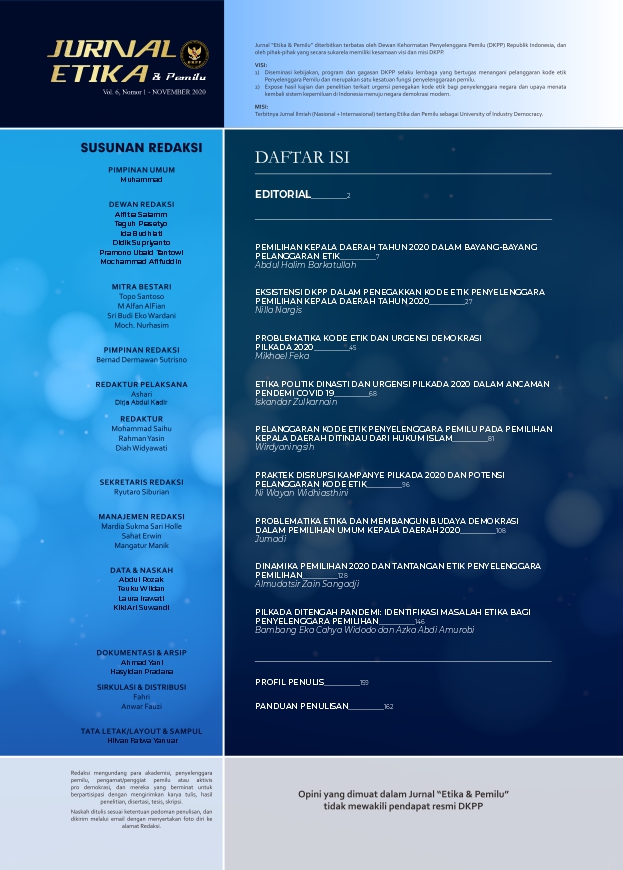
Problematika Kode Etik dan Urgensi Demokrasi Pilkada 2020
Abstrak
Konkretisasi dari pelaksanaan kedaulatan rakyat adalah pelaksanaan pemilu atau pilkada secara berkesinambungan. Untuk mewujudkan kedaulatan rakyat tersebut maka dibutuhkan penyelenggara pemilu yang berkualitas dan berpegang teguh pada asas-asas penyelenggara pemilu, yakni mandiri, jujur, adil, kepastian hukum, tertib, terbuka, proporsional, profesional, akuntabel, efektif dan efisien. Tidaklah gampang bagi penyelenggara pemilu untuk menciptakan suatu kondisi yang kondusif, baik secara aturan (undang-undang) maupun secara etik dalam penyelenggaran pilkada di tengah pandemi virus corona 2019 (covid-19). Keberhasilan pilkada di tahun 2020 tidak semata-mata ditentukan oleh penyelenggara pemilu, khususnya Komisi Pemilihan Umum (KPU) dan Badan Pengawas Pemilihan Umum (Bawaslu) beserta jajarannya masing-masing tetapi juga patut didukung sepenuhnya, baik oleh peserta pilkada/pasangan calon, partai politik, tim kampanye, masyarakat maupun semua stakeholder yang ada. Dewan Kehormatan Penyelenggara Pemilu (DKPP) sebagai lembaga yang diamatkan oleh UU Nomor 7 Tahun 2017 tentang Pemilu untuk menjaga marwah penyelenggara pemilu melalui penegakan kode etik yang bermatabat adalah sebuah keharusan walaupun ada beberapa tantangan yang berpotensi dialami dalam menegakkan etik tersebut, yakni DKPP bersifat pasif. Jangkauan kode etik secara normatif terbatas, sifat putusan yang final dan mengikat mulai terusik, dan penyesuaian sidang kode etik dilakukan ala covid-19 (masalah video conference versus keyakinan majelis). Pelaksanaan pilkada di tengah pandemi merupakan ujian bagi penyelenggara pemilu untuk benar-benar patuh pada kode etik dan hukum demi terciptanya pilkada berkualitas.
Diterbitkan
Terbitan
Bagian
Lisensi
License Terms
1. Copyright Policy
Authors who publish with Jurnal Etika dan Pemilu retain the copyright to their work. By submitting a manuscript, authors grant the journal the right of first publication, with the work simultaneously licensed under a Creative Commons Attribution-NonCommercial 4.0 International License (CC BY-NC 4.0).
2. Creative Commons Attribution-NonCommercial 4.0 (CC BY-NC 4.0)
This license allows others to:
-
Share: Copy and redistribute the material in any medium or format.
-
Adapt: Remix, transform, and build upon the material.
Under the following terms:
-
Attribution: You must give appropriate credit, provide a link to the license, and indicate if changes were made. You may do so in any reasonable manner, but not in any way that suggests the licensor endorses you or your use.
-
NonCommercial: You may not use the material for commercial purposes.
3. Author Rights
Authors retain the right to:
-
Archive their own articles in institutional or subject-based repositories (such as university websites).
-
Use their articles in their own future work, including lectures, books, or personal compilations.
-
Retain intellectual property rights without restrictions, provided that the original publication in Jurnal Etika dan Pemilu is properly cited.
4. User Responsibilities
Users of the journal website must comply with the following:
-
Any redistribution of published content must include a clear citation of the original article, including the author’s name, the title of the article, the journal name, the volume/issue number, and the DOI link.
-
Commercial reproduction or distribution of any content published in this journal is strictly prohibited without the express written permission of the copyright holder (the author) and the journal publisher (DKPP).
5. Third-Party Content
Some materials (such as images, tables, or data sets) published within an article may be subject to third-party copyright. It is the responsibility of the author to ensure that all necessary permissions have been obtained for the inclusion of such materials prior to submission.