
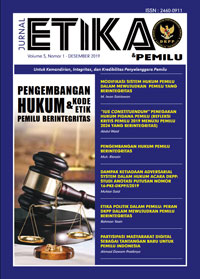
Pengembangan Hukum Pemilu Berintegritas
Abstrak
Politik hukum pemilu yang hendak mewujudkan pemilu berintegritas lahir dari norma konstitusi, Pasal 23 E ayat (1) dan ayat (5) Undang Undang Dasar Negara Republik Indonesia Tahun 1924 (UUD 1945). Asas pemilu jujur, adil, dan KPU yang mandiri menjadi pijakan konstitusional penyelenggaraan pemilu berintegritas, namun Undang Undang Nomor 7 Tahun 2017 tentang Pemilu sebagai kaidah pemilu berintegritas tidak memberikan penjelasan asas-asas hukum pemilu yang diatur dalam konstitusi. Kelembagaan hukum penyelenggaraan pemilu berintegritas melalui sistem pemilu berintegritas melalui KPU, Bawaslu, dan DKPP memiliki kelemahan karena Bawaslu dan DKPP belum diatur dalam konstitusi sebagaimana KPU. Proses hukum pemilu berintegritas juga masih memiliki hambatan karena ketidakseragaman lembaga yang memiliki kewenangan penegak etika antara PPK, PPS, KPPS, PPLN, KPPSLN serta anggota Panwaslu Kecamatan, Panwaslu Kelurahan/Desa, Panwaslu LN, dan Pengawas TPS yang tidak diselesaikan oleh DKPP dengan dugaan pelanggaran kode etik yang dilakukan oleh anggota KPU, anggota KPU Provinsi, anggota KPU Kabupaten/Kota, anggota Bawaslu, anggota Bawaslu Provinsi dan anggota Bawaslu Kabupaten/Kota yang diselesaikan oleh DKPP. Arah pengembangan hukum pemilu berintegritas ke depan hendaknya diarahkan untuk; pertama, memberikan penjelasan makna setiap asas-asas hukum pemilu dalam pasal 2 dan pasal 3 UU Pemilu. Kedua, DKPP dan Bawaslu hendaknya dipikirkan melalui kajian akademik untuk masuk menjadi bagian dari sistem pelaksanaan pemilu yang diatur juga keberadaan lembaganya dalam konstitusi. Ketiga, hendaknya diarahkan untuk membentuk perwakilan DKPP di daerah yang memiliki kewenangan untuk mengadili dugaan pelanggaran etika oleh oleh PPK, PPS, KPPS, PPLN, KPPSLN serta anggota Panwaslu Kecamatan, Panwaslu Kelurahan/Desa, Panwaslu LN, dan Pengawas TPS.
Diterbitkan
Terbitan
Bagian
Lisensi
License Terms
1. Copyright Policy
Authors who publish with Jurnal Etika dan Pemilu retain the copyright to their work. By submitting a manuscript, authors grant the journal the right of first publication, with the work simultaneously licensed under a Creative Commons Attribution-NonCommercial 4.0 International License (CC BY-NC 4.0).
2. Creative Commons Attribution-NonCommercial 4.0 (CC BY-NC 4.0)
This license allows others to:
-
Share: Copy and redistribute the material in any medium or format.
-
Adapt: Remix, transform, and build upon the material.
Under the following terms:
-
Attribution: You must give appropriate credit, provide a link to the license, and indicate if changes were made. You may do so in any reasonable manner, but not in any way that suggests the licensor endorses you or your use.
-
NonCommercial: You may not use the material for commercial purposes.
3. Author Rights
Authors retain the right to:
-
Archive their own articles in institutional or subject-based repositories (such as university websites).
-
Use their articles in their own future work, including lectures, books, or personal compilations.
-
Retain intellectual property rights without restrictions, provided that the original publication in Jurnal Etika dan Pemilu is properly cited.
4. User Responsibilities
Users of the journal website must comply with the following:
-
Any redistribution of published content must include a clear citation of the original article, including the author’s name, the title of the article, the journal name, the volume/issue number, and the DOI link.
-
Commercial reproduction or distribution of any content published in this journal is strictly prohibited without the express written permission of the copyright holder (the author) and the journal publisher (DKPP).
5. Third-Party Content
Some materials (such as images, tables, or data sets) published within an article may be subject to third-party copyright. It is the responsibility of the author to ensure that all necessary permissions have been obtained for the inclusion of such materials prior to submission.