
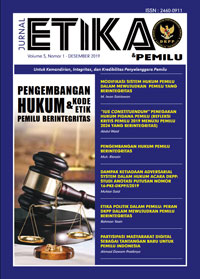
Dampak Ketiadaan Adversarial System Dalam Hukum Acara DKPP : Studi Anotasi Putusan Nomor 16-PKE-DKPP/I/2019
Abstrak
DKPP mempunyai kewenangan untuk menguji pelanggaran etika yang dilakukan oleh anggota penyelenggara pemilu. Dengan adanya DKPP maka diharapkan anggota penyelenggara pemilu bisa menjalankan tugas dan kewajibannya dengan menjunjung nilai-nilai integritas yang melekat pada dirinya. Menjadi pertanyaan, apabila putusan DKPP yang seharusnya memberikan dorongan kepada penyelenggara pemilu supaya menjaga integritasnya, namun dalam amar putusannya terkesan memberikan peluang bagi penyelenggara pemilu untuk melanggara nilai-nilai integritasnya sebagai penyelenggara pemilu. Permasalahan ini muncul dalam putusan DKPP No 16-PKE-DKPP/I/2019. Dalam putusan. Persoalan ini dibahas menggunakan metode pendekatan yuridis normative dan yuridis empiris. ada persoalan dalam hukum acara DKKP yang tidak mencantumkan kualitas alat bukti secara seimbang karena kualitas alat bukti hanya dibebankan pada Pengadu sedangkan Teradu tidak diberikan pedoman yang jelas dalam melakukan pembuktian
Diterbitkan
Terbitan
Bagian
Lisensi
License Terms
1. Copyright Policy
Authors who publish with Jurnal Etika dan Pemilu retain the copyright to their work. By submitting a manuscript, authors grant the journal the right of first publication, with the work simultaneously licensed under a Creative Commons Attribution-NonCommercial 4.0 International License (CC BY-NC 4.0).
2. Creative Commons Attribution-NonCommercial 4.0 (CC BY-NC 4.0)
This license allows others to:
-
Share: Copy and redistribute the material in any medium or format.
-
Adapt: Remix, transform, and build upon the material.
Under the following terms:
-
Attribution: You must give appropriate credit, provide a link to the license, and indicate if changes were made. You may do so in any reasonable manner, but not in any way that suggests the licensor endorses you or your use.
-
NonCommercial: You may not use the material for commercial purposes.
3. Author Rights
Authors retain the right to:
-
Archive their own articles in institutional or subject-based repositories (such as university websites).
-
Use their articles in their own future work, including lectures, books, or personal compilations.
-
Retain intellectual property rights without restrictions, provided that the original publication in Jurnal Etika dan Pemilu is properly cited.
4. User Responsibilities
Users of the journal website must comply with the following:
-
Any redistribution of published content must include a clear citation of the original article, including the author’s name, the title of the article, the journal name, the volume/issue number, and the DOI link.
-
Commercial reproduction or distribution of any content published in this journal is strictly prohibited without the express written permission of the copyright holder (the author) and the journal publisher (DKPP).
5. Third-Party Content
Some materials (such as images, tables, or data sets) published within an article may be subject to third-party copyright. It is the responsibility of the author to ensure that all necessary permissions have been obtained for the inclusion of such materials prior to submission.