
Existency Of DKPP In Enforcement Of The Organizers Code Of Conduct For 2020 Head Regional Election
Abstract
The implementation of regional head election is an effort to manifest democracy at the local level that people are able to directly elect the candidates for their regional head. However, in its development, the implementation of regional election has become a polemic regarding the covid-19 pandemic in the world including Indonesia.If the election will continue to be implemented there is a risk of increasing number of sufferers and if it is not implemented there will be no development in the regions because there is no definitive regional head.In addition the function of DKPP as an ethical enforcement agency for election organizers has received serious attention related to the partial authority of DKPP. DKPP only assessed the ethics of the election organizers but they ignored it when the election organizers did not comply with the covid-19 protocol in the implementation of the election stages.This research used qualitative methode with the type of concept analysis. The data collection technique used literature study that come from books, articles, journal,and various news in the mass media.The secondary data, the author get through interview with informant who is positioned as election organizers. The result of the analysis that authority needs to be strengthened of DKPP not only ethical enforcement but also enforcement of covid-19 protocol.
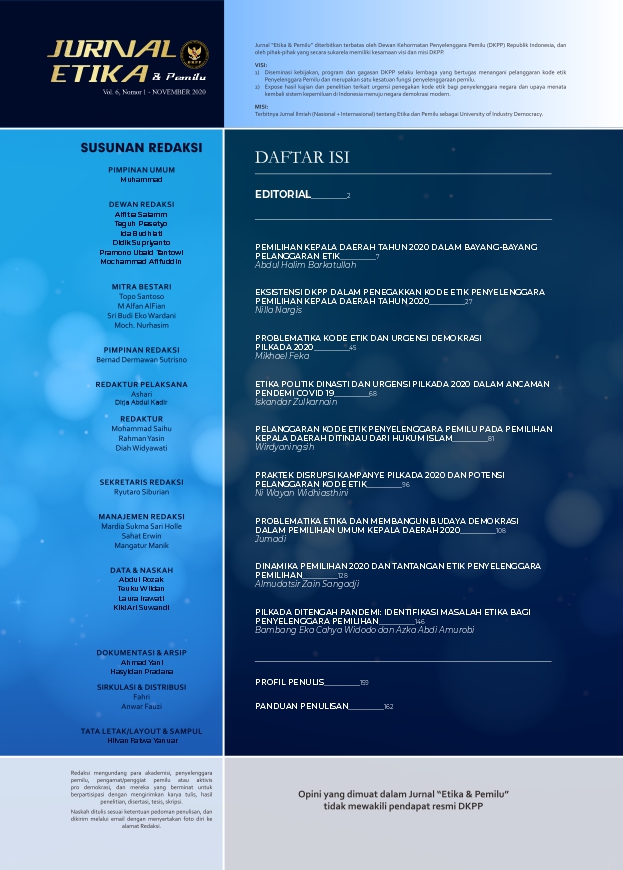
Published
Issue
Section
License
License Terms
1. Copyright Policy
Authors who publish with Jurnal Etika dan Pemilu retain the copyright to their work. By submitting a manuscript, authors grant the journal the right of first publication, with the work simultaneously licensed under a Creative Commons Attribution-NonCommercial 4.0 International License (CC BY-NC 4.0).
2. Creative Commons Attribution-NonCommercial 4.0 (CC BY-NC 4.0)
This license allows others to:
-
Share: Copy and redistribute the material in any medium or format.
-
Adapt: Remix, transform, and build upon the material.
Under the following terms:
-
Attribution: You must give appropriate credit, provide a link to the license, and indicate if changes were made. You may do so in any reasonable manner, but not in any way that suggests the licensor endorses you or your use.
-
NonCommercial: You may not use the material for commercial purposes.
3. Author Rights
Authors retain the right to:
-
Archive their own articles in institutional or subject-based repositories (such as university websites).
-
Use their articles in their own future work, including lectures, books, or personal compilations.
-
Retain intellectual property rights without restrictions, provided that the original publication in Jurnal Etika dan Pemilu is properly cited.
4. User Responsibilities
Users of the journal website must comply with the following:
-
Any redistribution of published content must include a clear citation of the original article, including the author’s name, the title of the article, the journal name, the volume/issue number, and the DOI link.
-
Commercial reproduction or distribution of any content published in this journal is strictly prohibited without the express written permission of the copyright holder (the author) and the journal publisher (DKPP).
5. Third-Party Content
Some materials (such as images, tables, or data sets) published within an article may be subject to third-party copyright. It is the responsibility of the author to ensure that all necessary permissions have been obtained for the inclusion of such materials prior to submission.