
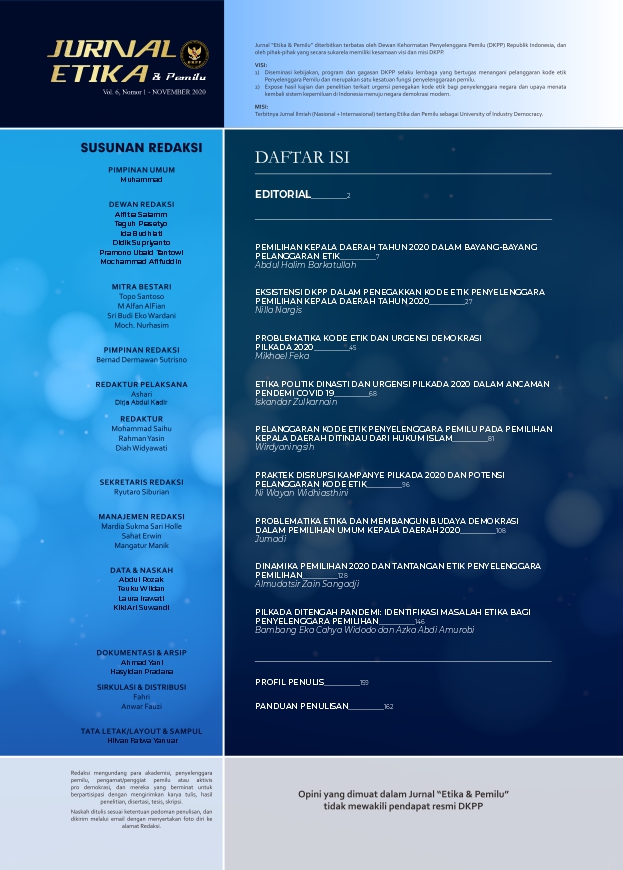
Problematika Kode Etik dan Urgensi Demokrasi Pilkada 2020
Abstract
The concretization of the implementation of people's sovereignty is the sustainable implementation of elections or regional elections. To realize the sovereignty of the people, the quality of election organizers is really needed. The election organizers have to keep the principles of election administration firmly. Those principles are independent, honest, fair, legal certainty, orderly, open, proportional, professional, accountable, effective and efficient. It is not easy for the election organizers to create conducive conditions, both in terms of regulations (laws) and in terms of ethics in organizing regional elections amid the pandemic of corona virus 2019 (covid-19. The success of the elections in 2020 is not only determined by the election organizers, especially General Elections Commission (KPU) and Election Supervisory Agency (Bawaslu) along with their own staff, but also it is fully supported by either district heads election (Pilkada) participants (candidate pairs), political parties, campaign teams, communities, or all existing stakeholders. Election Organizer Ethics Council (DKPP) as an institution protected by Law Number 7 of 2017 concerning Elections to maintain the election organizers’dignity through enforcement of a dignified ethic code is a must, although there are several challenges that can potentially be experienced in upholding this ethic, that is to say, DKPP is passive. The scope of the ethic code is normatively limited; the nature of the final and binding decision has begun to be disturbed; and adjustments to the ethic code trial has begun to be based on the covid-19 one (the issue of video conference versus assembly beliefs). The implementation of elections amid a pandemic is a test for election organizers to truly comply with the ethic code and law in order to create quality elections.
Published
Issue
Section
License
License Terms
1. Copyright Policy
Authors who publish with Jurnal Etika dan Pemilu retain the copyright to their work. By submitting a manuscript, authors grant the journal the right of first publication, with the work simultaneously licensed under a Creative Commons Attribution-NonCommercial 4.0 International License (CC BY-NC 4.0).
2. Creative Commons Attribution-NonCommercial 4.0 (CC BY-NC 4.0)
This license allows others to:
-
Share: Copy and redistribute the material in any medium or format.
-
Adapt: Remix, transform, and build upon the material.
Under the following terms:
-
Attribution: You must give appropriate credit, provide a link to the license, and indicate if changes were made. You may do so in any reasonable manner, but not in any way that suggests the licensor endorses you or your use.
-
NonCommercial: You may not use the material for commercial purposes.
3. Author Rights
Authors retain the right to:
-
Archive their own articles in institutional or subject-based repositories (such as university websites).
-
Use their articles in their own future work, including lectures, books, or personal compilations.
-
Retain intellectual property rights without restrictions, provided that the original publication in Jurnal Etika dan Pemilu is properly cited.
4. User Responsibilities
Users of the journal website must comply with the following:
-
Any redistribution of published content must include a clear citation of the original article, including the author’s name, the title of the article, the journal name, the volume/issue number, and the DOI link.
-
Commercial reproduction or distribution of any content published in this journal is strictly prohibited without the express written permission of the copyright holder (the author) and the journal publisher (DKPP).
5. Third-Party Content
Some materials (such as images, tables, or data sets) published within an article may be subject to third-party copyright. It is the responsibility of the author to ensure that all necessary permissions have been obtained for the inclusion of such materials prior to submission.