
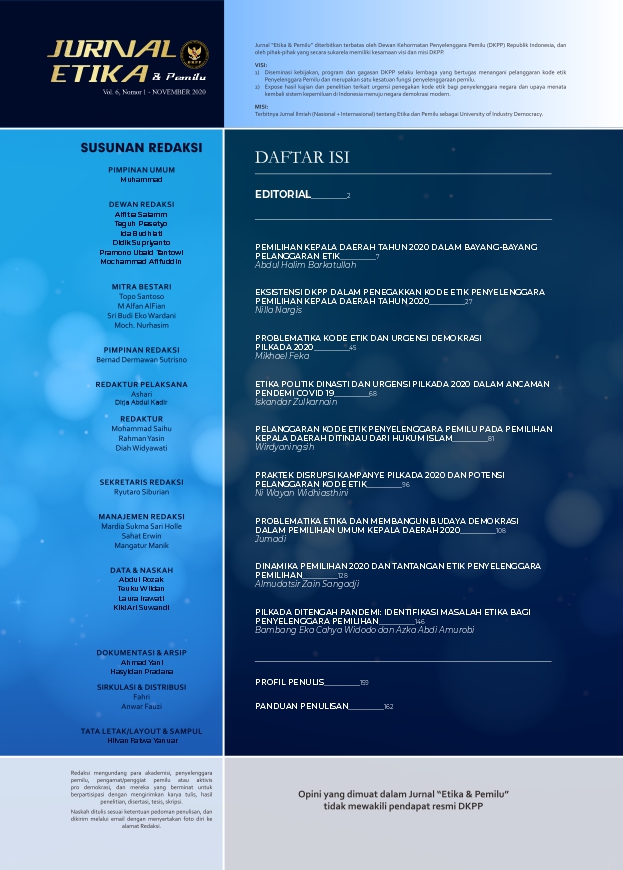
Etika politik dinasti dan urgensi Pilkada 2020 dalam ancaman pendemi covid 19
Abstract
The 2020 Pilkada feels different from the previous pilkada. The Pilkada event this time was held in a situation of the outbreak of the Covid-19 Pandemic which has not ended in Indonesia and also in many countries in the world. Apart from the Covid-19 Pandemic, this year's Pilkada was also marked by the re-emergence of “dynastic politics”, namely by the presence of candidates in several regional head elections who come from ruling families and high-ranking officials of this country, who are ready to fight for regional head seats. The holding of the 2020 Pilkada amid the Covid 19 pandemic and the spread of dynastic politics has become a paradox for the portrait of democratic life in Indonesia today. A wise and prudent policy is needed from the government and election management apparatus in Indonesia. The government and politicians of this country must draft regulations regarding whether or not close relatives can run as executive or legislative officials. This is felt to be very necessary in an effort to build sound political ethics and prevent dynastic political culture which seriously injures the development of good democracy. The 2020 Pilkada also did not make the spread of Covid 19 more widespread. The application of e-Voting can be a solution. The implementation of e-Voting can be the solution during the 2020 Pilkada to ensuring Covid 19 viruses not spread. This is because e-Voting offers a rationalization of the reasons against Covid 19 which overshadows the implementation of the stages of the Pilkada stages, starting from candidate registration, candidate announcement , the campaign stage, the voting period, to the announcement of the results of the Pilkada. e - Voting offers benefits, such ensuring that physical distancing will be maintained, easy voting, preventing the center of the crowd, offering speed and data accuracy.
Published
Issue
Section
License
License Terms
1. Copyright Policy
Authors who publish with Jurnal Etika dan Pemilu retain the copyright to their work. By submitting a manuscript, authors grant the journal the right of first publication, with the work simultaneously licensed under a Creative Commons Attribution-NonCommercial 4.0 International License (CC BY-NC 4.0).
2. Creative Commons Attribution-NonCommercial 4.0 (CC BY-NC 4.0)
This license allows others to:
-
Share: Copy and redistribute the material in any medium or format.
-
Adapt: Remix, transform, and build upon the material.
Under the following terms:
-
Attribution: You must give appropriate credit, provide a link to the license, and indicate if changes were made. You may do so in any reasonable manner, but not in any way that suggests the licensor endorses you or your use.
-
NonCommercial: You may not use the material for commercial purposes.
3. Author Rights
Authors retain the right to:
-
Archive their own articles in institutional or subject-based repositories (such as university websites).
-
Use their articles in their own future work, including lectures, books, or personal compilations.
-
Retain intellectual property rights without restrictions, provided that the original publication in Jurnal Etika dan Pemilu is properly cited.
4. User Responsibilities
Users of the journal website must comply with the following:
-
Any redistribution of published content must include a clear citation of the original article, including the author’s name, the title of the article, the journal name, the volume/issue number, and the DOI link.
-
Commercial reproduction or distribution of any content published in this journal is strictly prohibited without the express written permission of the copyright holder (the author) and the journal publisher (DKPP).
5. Third-Party Content
Some materials (such as images, tables, or data sets) published within an article may be subject to third-party copyright. It is the responsibility of the author to ensure that all necessary permissions have been obtained for the inclusion of such materials prior to submission.