
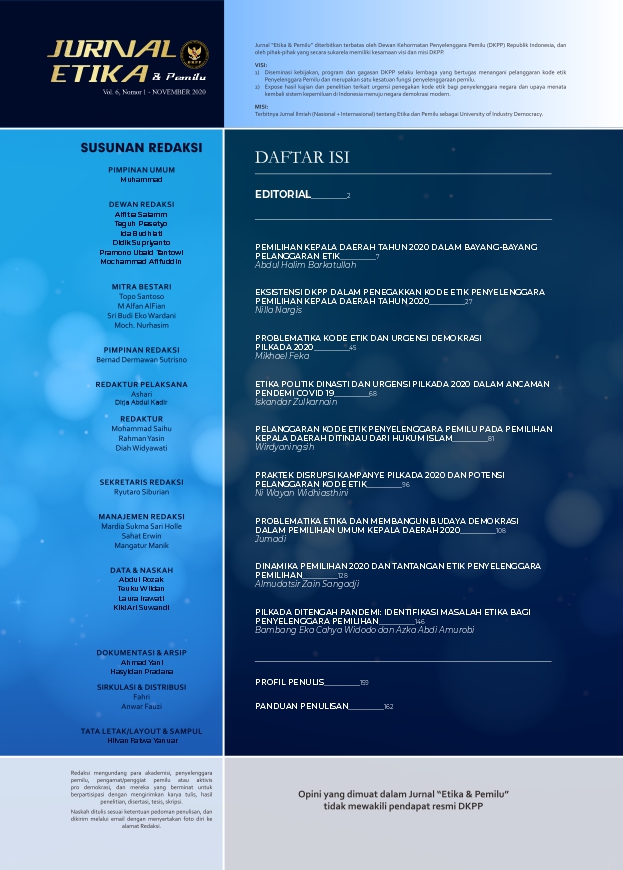
Pelanggaran Kode Etik Penyelenggara Pemilu Pada Pemilihan Kepala Daerah Ditinjau dari Hukum Islam
Abstract
Data on violations of the Election Organizer code of ethics until 2020 tends to increase. The possibility is increasing considering the simultaneous regional elections in 2020 are in covid pandemic. The main problem of this paper is related to the regulation of the code of ethics in terms of Islamic Law and the problem of violating the Code of Ethics by Election. The majority of the organizers, election participants and reporters in the code of ethics trial are Muslim, so it’s interesting to study them with normative juridical analysis. Islam does’nt recognize a strict separation between law and ethics. Ethics is a part of morals that concerns human behavior that’s outward in nature, and also includes broader matters, namely faith, worship, and sharia. Violation of the code of ethics can be prevented by carrying out the values of piety by referring to three aspects, namely al-karîmah morals, uswatun hasanah and rahmatun li al-'âlamîn.
Published
Issue
Section
License
License Terms
1. Copyright Policy
Authors who publish with Jurnal Etika dan Pemilu retain the copyright to their work. By submitting a manuscript, authors grant the journal the right of first publication, with the work simultaneously licensed under a Creative Commons Attribution-NonCommercial 4.0 International License (CC BY-NC 4.0).
2. Creative Commons Attribution-NonCommercial 4.0 (CC BY-NC 4.0)
This license allows others to:
-
Share: Copy and redistribute the material in any medium or format.
-
Adapt: Remix, transform, and build upon the material.
Under the following terms:
-
Attribution: You must give appropriate credit, provide a link to the license, and indicate if changes were made. You may do so in any reasonable manner, but not in any way that suggests the licensor endorses you or your use.
-
NonCommercial: You may not use the material for commercial purposes.
3. Author Rights
Authors retain the right to:
-
Archive their own articles in institutional or subject-based repositories (such as university websites).
-
Use their articles in their own future work, including lectures, books, or personal compilations.
-
Retain intellectual property rights without restrictions, provided that the original publication in Jurnal Etika dan Pemilu is properly cited.
4. User Responsibilities
Users of the journal website must comply with the following:
-
Any redistribution of published content must include a clear citation of the original article, including the author’s name, the title of the article, the journal name, the volume/issue number, and the DOI link.
-
Commercial reproduction or distribution of any content published in this journal is strictly prohibited without the express written permission of the copyright holder (the author) and the journal publisher (DKPP).
5. Third-Party Content
Some materials (such as images, tables, or data sets) published within an article may be subject to third-party copyright. It is the responsibility of the author to ensure that all necessary permissions have been obtained for the inclusion of such materials prior to submission.