
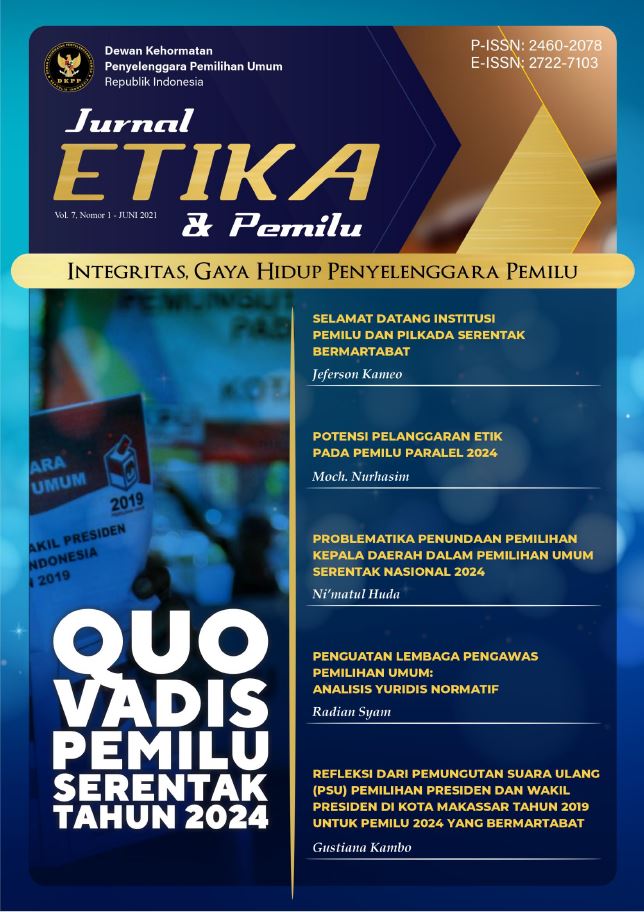
THE STRENTHENING OF GENERAL ELECTION INSTITUTION: NORMATIVE JURIDICAL ANALYS
Abstract
The strengthening towards the implementation of General Election supervision has been carried out through various amendments starting form Law No. 12 of the Year 2003, Law No. 22 of the year 2007, Law No. 15 of the Year 2011, up to Law UU No. 7 of the Year 2017 which constitutes he newest Law regarding General Election. The course of and the amendments to the laws aforesaid in the context of implementation and institutionalization of General Election supervision demonstrate changes in the position of the General Election supervision institution, which is increasingly strengthened, both from the institutional aspect and from its duties and authorities. However, the tendency of General Election violations almost always increases from one General Election to another. This matter causes General Election as the means of people’s sovereignty to be faced with a problem which simultaneously becomes challenges for the General Election supervision institution to present fair and equitable General Election, therefore, people’s sovereignty through the General Election process can be implemented. This research has the objective of analyzing the concept of General Election supervision based on the currently prevailing positive law in Indonesia. The type of this research is normative juridical. The data being used are secondary data in the form of primary, secondary, and tertiary legal sources. This research concludes that the General Election supervisory institution must continue to be strengthened considering the progressively complex
challenges and obstacles and the increasing tendency of violations. In this case, the researcher offers the concept of strengthening the General Election supervision through a clear and explicit stipulation in Article 22E of the Constitution of the State of the Republic of Indonesia of the Year 1945 by inserting a phrase stipulating the General Election supervisor which is separated from the onvening of the General Election, therefore, the concept of supervision over people’s sovereignty in the general election which is carried out by the General Election supervisory institution will be preponderant and will have coercive force in the decision since here is a separation between the General Election organizer and supervisor.
Published
Issue
Section
License
License Terms
1. Copyright Policy
Authors who publish with Jurnal Etika dan Pemilu retain the copyright to their work. By submitting a manuscript, authors grant the journal the right of first publication, with the work simultaneously licensed under a Creative Commons Attribution-NonCommercial 4.0 International License (CC BY-NC 4.0).
2. Creative Commons Attribution-NonCommercial 4.0 (CC BY-NC 4.0)
This license allows others to:
-
Share: Copy and redistribute the material in any medium or format.
-
Adapt: Remix, transform, and build upon the material.
Under the following terms:
-
Attribution: You must give appropriate credit, provide a link to the license, and indicate if changes were made. You may do so in any reasonable manner, but not in any way that suggests the licensor endorses you or your use.
-
NonCommercial: You may not use the material for commercial purposes.
3. Author Rights
Authors retain the right to:
-
Archive their own articles in institutional or subject-based repositories (such as university websites).
-
Use their articles in their own future work, including lectures, books, or personal compilations.
-
Retain intellectual property rights without restrictions, provided that the original publication in Jurnal Etika dan Pemilu is properly cited.
4. User Responsibilities
Users of the journal website must comply with the following:
-
Any redistribution of published content must include a clear citation of the original article, including the author’s name, the title of the article, the journal name, the volume/issue number, and the DOI link.
-
Commercial reproduction or distribution of any content published in this journal is strictly prohibited without the express written permission of the copyright holder (the author) and the journal publisher (DKPP).
5. Third-Party Content
Some materials (such as images, tables, or data sets) published within an article may be subject to third-party copyright. It is the responsibility of the author to ensure that all necessary permissions have been obtained for the inclusion of such materials prior to submission.