
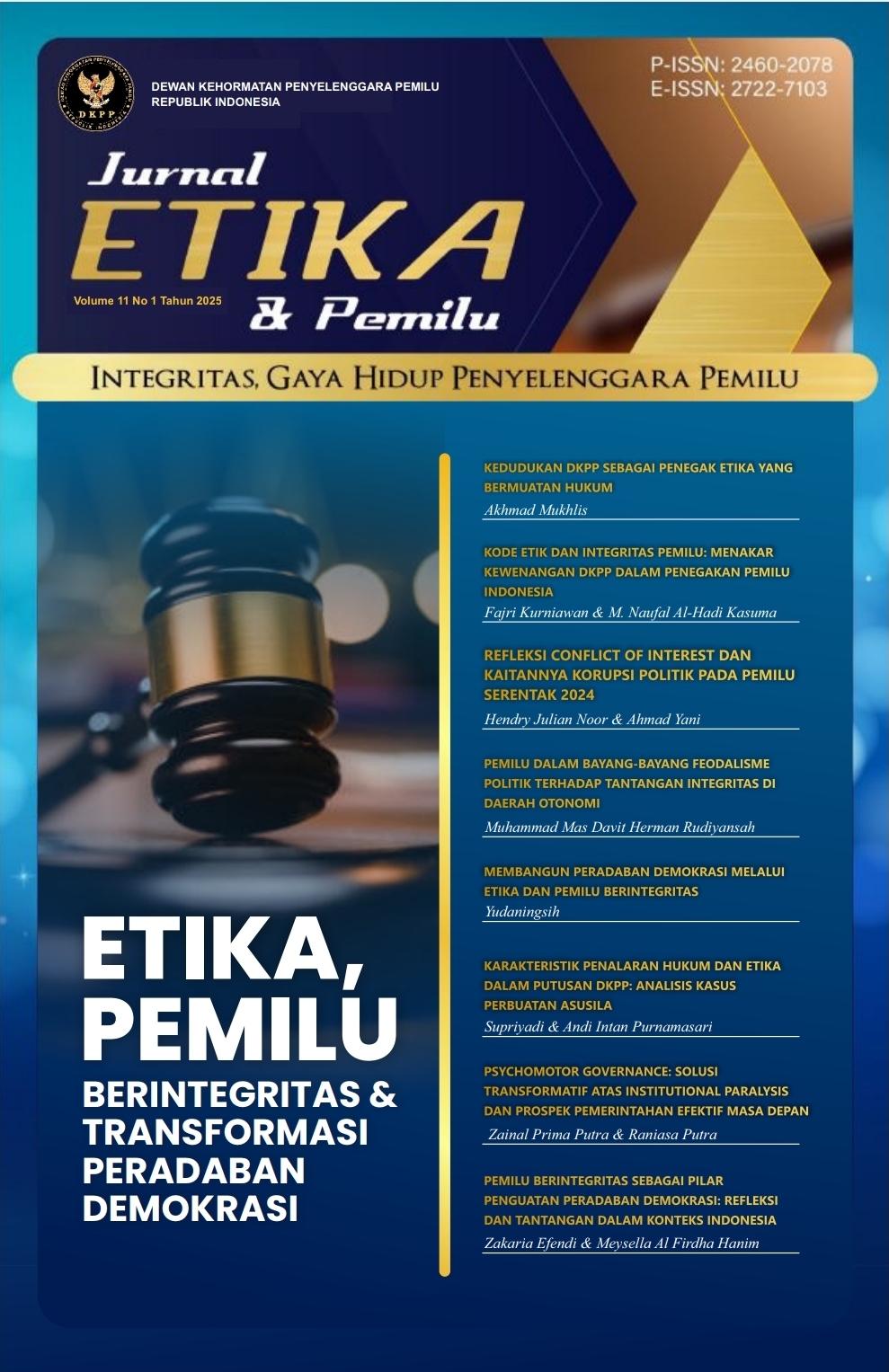
ELECTIONS IN THE SHADOW OF POLITICAL FE DALISM TOWARDS THE CHALLENGES OF INTEGRITY IN AUTONOMOUS REGIONS
Abstract
Elections in Indonesia’s autonomous regions are not only an arena for po- litical competition but also a space rife with feudal practices, particularly through dynastic politics and personal loyalties. This paper examines how election regulations work using a normative juridical technique and a so- cio-legal perspective, local political culture, and patronage dynamics influ- ence the integrity of electoral democracy. The results show that dynastic politics thrive due to weak regulations and oversight, and are reinforced by the pragmatic attitudes of political parties that prioritize electability over cadre development. Meanwhile, the community’s personal loyalty to leadership figures, rooted in a paternalistic culture and patron-client net- works, creates serious distortions of the principle of freedom of choice. This condition reduces transparency, accountability, and fairness in elec- tions, while simultaneously narrowing the space for citizen political partici- pation. Therefore, improving election integrity through regulatory reform, strengthening political parties, and public political education is an urgent agenda to ensure that local democracy is more inclusive, accountable, and oriented towards popular sovereignty.
Downloads
Published
Issue
Section
License
License Terms
1. Copyright Policy
Authors who publish with Jurnal Etika dan Pemilu retain the copyright to their work. By submitting a manuscript, authors grant the journal the right of first publication, with the work simultaneously licensed under a Creative Commons Attribution-NonCommercial 4.0 International License (CC BY-NC 4.0).
2. Creative Commons Attribution-NonCommercial 4.0 (CC BY-NC 4.0)
This license allows others to:
-
Share: Copy and redistribute the material in any medium or format.
-
Adapt: Remix, transform, and build upon the material.
Under the following terms:
-
Attribution: You must give appropriate credit, provide a link to the license, and indicate if changes were made. You may do so in any reasonable manner, but not in any way that suggests the licensor endorses you or your use.
-
NonCommercial: You may not use the material for commercial purposes.
3. Author Rights
Authors retain the right to:
-
Archive their own articles in institutional or subject-based repositories (such as university websites).
-
Use their articles in their own future work, including lectures, books, or personal compilations.
-
Retain intellectual property rights without restrictions, provided that the original publication in Jurnal Etika dan Pemilu is properly cited.
4. User Responsibilities
Users of the journal website must comply with the following:
-
Any redistribution of published content must include a clear citation of the original article, including the author’s name, the title of the article, the journal name, the volume/issue number, and the DOI link.
-
Commercial reproduction or distribution of any content published in this journal is strictly prohibited without the express written permission of the copyright holder (the author) and the journal publisher (DKPP).
5. Third-Party Content
Some materials (such as images, tables, or data sets) published within an article may be subject to third-party copyright. It is the responsibility of the author to ensure that all necessary permissions have been obtained for the inclusion of such materials prior to submission.