
INTEGRITY IN ELECTION AS A PILAR OF STRENGTHENING DEMOCRATIC CIVILIZATION: REKLECTION AND CHALLENGES IN THE INDONESIAN CONTEXT
Abstract
Electoral integrity is a fundamental pillar for strengthening democra- cy, especially in the context of Indonesia, which faces electoral political complexity. This study analyzes the reflections and challenges that arise in elections in Indonesia through three main dimensions: money politics and campaign finance transparency, digital disinformation and political polar- ization, and the institutional capacity of election organizers and law en- forcement agencies. This study uses qualitative methods with document analysis, using monitoring agency reports, online news, and academic lit- erature as units of analysis through thematic content analysis. The results of this study show that money politics is still common, campaign finance reporting is not yet transparent, and digital disinformation reinforces polit- ical polarization. In addition, the capacity of electoral management bodies and law enforcement agencies is limited due to resources, complex reg- ulations, and political intervention. This study recommends the need for a comprehensive strategy covering political funding transparency, digital literacy, platform regulation, and strengthening the capacity and indepen- dence of electoral institutions for a healthy and sustainable democracy
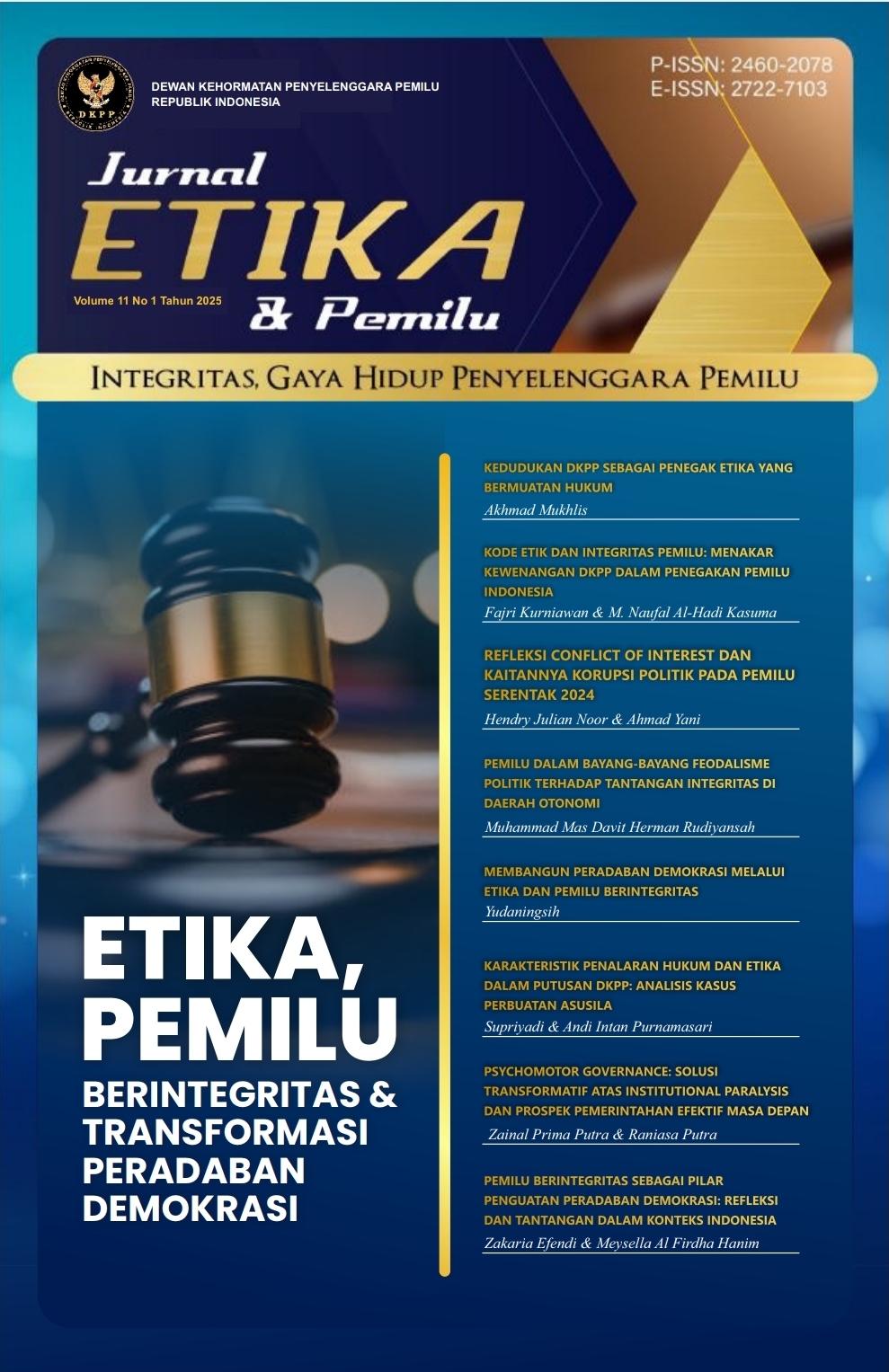
Downloads
Published
Issue
Section
License
License Terms
1. Copyright Policy
Authors who publish with Jurnal Etika dan Pemilu retain the copyright to their work. By submitting a manuscript, authors grant the journal the right of first publication, with the work simultaneously licensed under a Creative Commons Attribution-NonCommercial 4.0 International License (CC BY-NC 4.0).
2. Creative Commons Attribution-NonCommercial 4.0 (CC BY-NC 4.0)
This license allows others to:
-
Share: Copy and redistribute the material in any medium or format.
-
Adapt: Remix, transform, and build upon the material.
Under the following terms:
-
Attribution: You must give appropriate credit, provide a link to the license, and indicate if changes were made. You may do so in any reasonable manner, but not in any way that suggests the licensor endorses you or your use.
-
NonCommercial: You may not use the material for commercial purposes.
3. Author Rights
Authors retain the right to:
-
Archive their own articles in institutional or subject-based repositories (such as university websites).
-
Use their articles in their own future work, including lectures, books, or personal compilations.
-
Retain intellectual property rights without restrictions, provided that the original publication in Jurnal Etika dan Pemilu is properly cited.
4. User Responsibilities
Users of the journal website must comply with the following:
-
Any redistribution of published content must include a clear citation of the original article, including the author’s name, the title of the article, the journal name, the volume/issue number, and the DOI link.
-
Commercial reproduction or distribution of any content published in this journal is strictly prohibited without the express written permission of the copyright holder (the author) and the journal publisher (DKPP).
5. Third-Party Content
Some materials (such as images, tables, or data sets) published within an article may be subject to third-party copyright. It is the responsibility of the author to ensure that all necessary permissions have been obtained for the inclusion of such materials prior to submission.