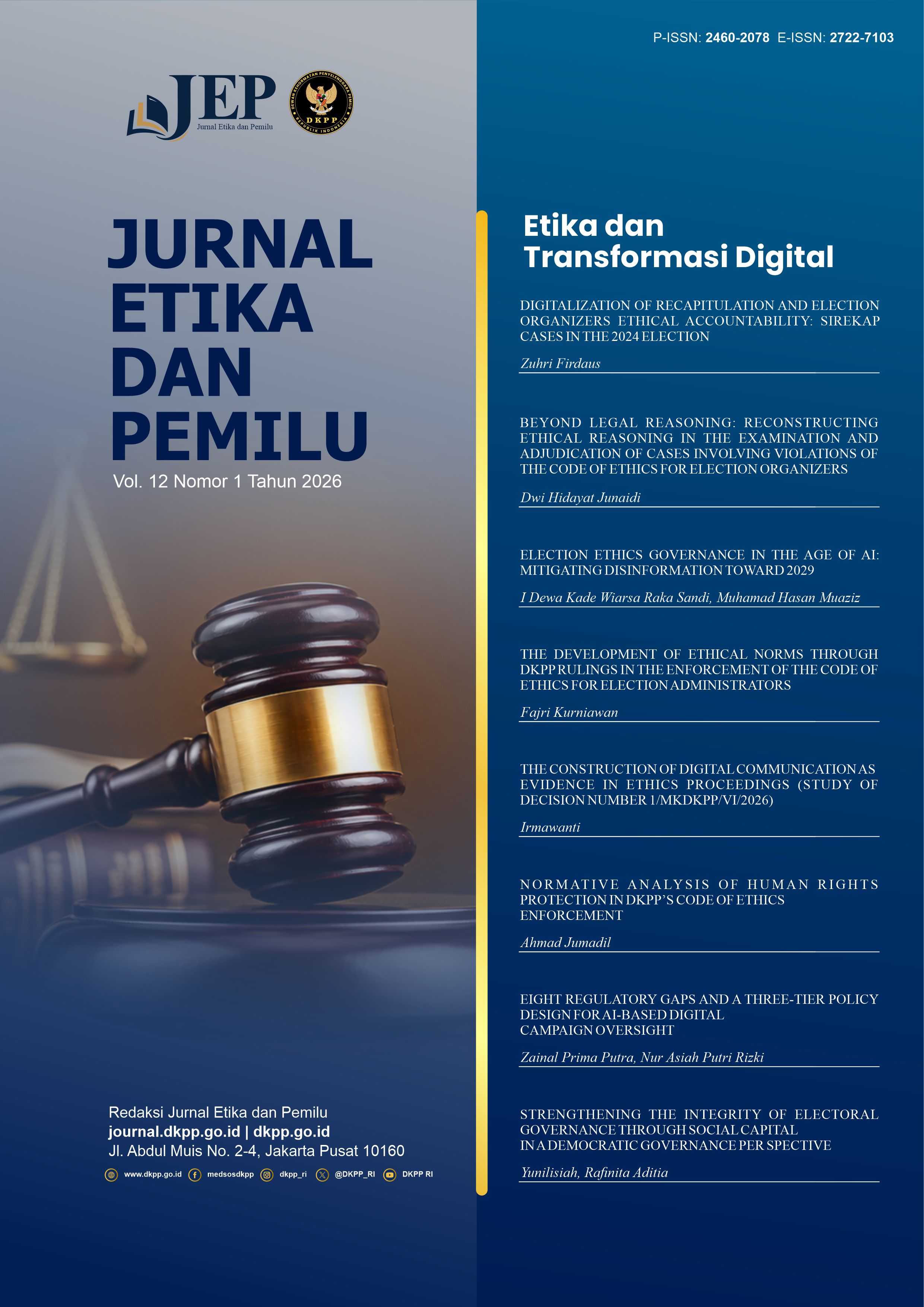
NORMATIVE ANALYSIS OF HUMAN RIGHTS PROTECTION IN DKPP'S CODE OF ETHICS ENFORCEMENT
DOI:
https://doi.org/10.68702/etikapemilu.336Keywords:
Human Rights,, Rights to Vote, Democratic Constitutional State, Election Ethics CodeAbstract
The enforcement of the code of ethics by the Honorary Council of Election Organizers (DKPP) has largely been understood as a mere institutional disciplinary mechanism, while its relation to the protection of citizens' political rights as part of human rights has received limited attention in prior literature. This study aims to analyze the position of the right to vote as a human right within Indonesia's democratic constitutional state, the position and function of DKPP in enforcing the code of ethics, and the implications of such enforcement for the protection of the right to vote. This study employs a normative legal method with statutory and conceptual approaches, analyzing primary and secondary legal materials descriptively and analytically. The findings show that the right to vote gives rise to a three-tiered state obligation—to respect, to protect, and to fulfil—and that DKPP's ethics enforcement is positioned within the to protect obligation, which is preventive-systemic rather than remedial-individual in nature. This study also identifies structural problems within DKPP, including its member appointment mechanism, evidentiary procedures, sanction certainty, and secretariat independence, which affect the effectiveness of this function. The study concludes that strengthening DKPP's institutional position is integral to fulfilling the state's constitutional obligation to protect citizens' political rights.
References
Anam, Khoirul. "Tantangan Penegakan Kode Etik Penyelenggara Pemilu Oleh Dewan Kehormatan Penyelenggara Pemilu (DKPP): Analisis Perspektif Undang-Undang No. 7 Tahun 2017 Tentang Pemilihan Umum." Journal of Contemporary Law Studies 2, no. 1 (2024): 85–98. https://doi.org/10.47134/lawstudies.v2i1.2318
Arifin, Wein. Peradilan Etik Pemilu: Menegakkan Integritas dan Kehormatan Penyelenggara Pemilu. Depok: Rajawali Pers, 2026.
Arifin, Wein, Sukamto Satoto, dan A. Zarkasi. "Reconstruction of the position and authority of the honorary council of general election organizers (DKPP) as a quasi ethical court of election organizers." Journal of Law and Regulation Governance 2, no. 9 (2024): 316-325. https://doi.org/10.62795/fjl.v4i2.274
Asshiddiqie, Jimly. Konstitusi dan Konstitusionalisme Indonesia. Edisi Revisi. Jakarta: Konstitusi Press, 2005.
Azzahra, Selma Nabila, dan Iman Hakiki. "Konsep Negara Hukum dan Demokrasi Serta Kaitannya dengan Hak Asasi Manusia." TERANG 2, no. 4 (Desember 2025): 196-202. https://doi.org/10.62383/terang.v2i4.1465
Bria, Herfein, Erikson Sihotang, dan Kadek Merry Herawati. "Kewenangan Dewan Kehormatan Penyelenggara Pemilu (DKPP) dalam Penegakan Etika Penyelenggara Pemilu." Nusantara Hasana Journal 4, no. 4 (September 2024): 109–133. https://doi.org/10.59003/nhj.v4i4.1232
Budiardjo, Miriam. Dasar-Dasar Ilmu Politik. Edisi Revisi. Jakarta: PT Gramedia Pustaka Utama, 2008.
Butarbutar, Frans Samuel Junero, dan Irwan Triadi. "Implementasi Prinsip Demokrasi dalam Sistem Hukum Tata Negara." Birokrasi: JURNAL ILMU HUKUM DAN TATA NEGARA 2, no. 3 (2024): 264–273. https://doi.org/10.55606/birokrasi.v2i3.1336
Ganti, Nurhikma, dkk. "Negara Demokrasi dan Hak Asasi Manusia di Indonesia." ALADALAH: Jurnal Politik, Sosial, Hukum dan Humaniora 2, no. 3 (2024): 215–222. https://doi.org/10.59246/aladalah.v2i3.883
Gustriani, Wulan Sari, dkk. "Perkembangan Ilmu Hukum Tata Negara Dalam Perspektif Demokrasi dan Rule of Law di Indonesia." Jurnal Sosial dan Sains (SOSAINS) 5, no. 9 (2025): 2781-2790. https://doi.org/10.59188/jurnalsosains.v5i9.32494
Hidayah, Syarifaatul. "State Responsibility in Protecting Human Rights: An International Legal Perspective." International Law Discourse in Southeast Asia 2, no. 2 (2023): 279–304. https://doi.org/10.15294/ildisea.v2i2.77145.
Hindiawati, Wahyu, dkk. "Penataan Kelembagaan Penyelenggara Pemilu Dan Pilkada Dalam Meningkatkan Integritas Demokrasi Di Indonesia." Jurnal Magister Hukum PERSPEKTIF 16 (2026): 170–186. https://doi.org/10.37303/magister.v16i2.131
Jatmiko, Bayu Dwiwiddy. "Menelisik Pengakuan dan Perlindungan Hak-Hak Asasi Politik Pasca Perubahan UUD 1945." Jurnal Panorama Hukum 3, no. 2 (Desember 2018): 217-246. https://doi.org/10.21067/JPH.V3I2.2827
Lardy, Heather. "Is There a Right Not to Vote?." Oxford Journal of Legal Studies 24, no. 2 (Summer 2004): 303–318. http://www.jstor.org/stable/3600594
Locke, John. Two Treatises of Government. Diedit oleh Peter Laslett. Student Edition. Cambridge: Cambridge University Press, 1988.
Marzuki, Peter Mahmud. Penelitian Hukum. Cetakan XV. Jakarta: Kencana, 2021.
Muhaimin. Metode Penelitian Hukum. Mataram: Mataram University Press, 2020.
Mukhlis, Akhmad. "Kedudukan DKPP sebagai Penegak Etika yang Bermuatan Hukum." Jurnal Etika dan Pemilu 11, no. 1 (2025): 11–23. https://journal.dkpp.go.id/index.php/etikapemilu/index
Mutawalli, Muhammad. Negara Hukum Kedaulatan dan Demokrasi (Konsepsi Teori dan Perkembangannya). Surabaya: Pustaka Aksara, 2023.
Nasoha, Ahmad Muhamad Mustain, dkk. "Kewarganegaraan dan Hak Politik: Analisis Undang-Undang tentang Hak Pilih Warga Negara di Indonesia." Referendum 1, no. 4 (November 2024): 116-125. https://doi.org/10.62383/referendum.v1i4.289.
Novriadi, Eka. "Penerapan Hukum Acara dalam Persidangan Terbuka Pelanggaran Kode Etik Penyelenggara Pemilu pada Pemilu Tahun 2019." Jurnal Darma Agung 30, no. 3 (Desember 2022): 1437–1456. https://doi.org/10.46930/ojsuda.v30i3.3308
Prasetyo, Teguh. DKPP RI Penegak Etik Penyelenggara Pemilu Bermartabat. Depok: Rajawali Pers, 2018.
Purnama, Taufiq Yuli, dan Sigit Sapto Nugroho. "Elections integrity: Realizing ultimate concern and electoral justice." Journal of Transcendental Law 5, no. 2 (2023): 107–122. https://doi.org/10.23917/jtl.v5i2.2386
Rahmalillah, Apriliani, Mahisa Mareati, dan Erham. "Kedudukan Dewan Kehormatan Penyelenggara Pemilu dalam Mewujudkan Akuntabilitas Penyelenggara Pemilu." QOSIM: Jurnal Pendidikan, Sosial & Humaniora 4, no. 3 (2026): 2123-2136. https://doi.org/10.61104/jq.v4i3.6712
Raka Sandi, I Dewa Kade Wiarsa, dkk., ed. Etika yang Melembaga: 70 Tahun Prof. Jimly Asshiddiqie Warisan Gagasan dan Penguatan DKPP. Jakarta: Sinar Grafika, 2026.
Soekanto, Soerjono. Pengantar Penelitian Hukum. Cetakan III. Jakarta: Universitas Indonesia Press, 1986.
Weber, Max. Politics as a Vocation. Diterjemahkan oleh H. H. Gerth dan C. Wright Mills. Philadelphia: Fortress Press, 1965.
Dewan Kehormatan Penyelenggara Pemilu. Laporan Kinerja DKPP Tahun 2025. Jakarta: DKPP, 2025.
Office of the United Nations High Commissioner for Human Rights (OHCHR). Frequently Asked Questions on a Human Rights-Based Approach to Development Cooperation. HR/PUB/06/8. New York dan Geneva: United Nations, 2006.
Undang-Undang Nomor 7 Tahun 2017 tentang Pemilihan Umum.
Peraturan Menteri Dalam Negeri Nomor 10 Tahun 2019 tentang Organisasi dan Tata Kerja Sekretariat Dewan Kehormatan Penyelenggara Pemilihan Umum. Berita Negara Republik Indonesia Tahun 2019 Nomor 170.
Peraturan Dewan Kehormatan Penyelenggara Pemilihan Umum Nomor 2 Tahun 2019 tentang Perubahan atas Peraturan Dewan Kehormatan Penyelenggara Pemilihan Umum Nomor 3 Tahun 2017 tentang Pedoman Beracara Kode Etik Penyelenggara Pemilihan Umum. Berita Negara Republik Indonesia Tahun 2019 Nomor 291.
United Nations General Assembly. International Covenant on Civil and Political Rights. 16 Desember 1966. General Assembly Resolution 2200A (XXI).
Downloads
Published
Issue
Section
License
License Terms
1. Copyright Policy
Authors who publish with Jurnal Etika dan Pemilu retain the copyright to their work. By submitting a manuscript, authors grant the journal the right of first publication, with the work simultaneously licensed under a Creative Commons Attribution-NonCommercial 4.0 International License (CC BY-NC 4.0).
2. Creative Commons Attribution-NonCommercial 4.0 (CC BY-NC 4.0)
This license allows others to:
-
Share: Copy and redistribute the material in any medium or format.
-
Adapt: Remix, transform, and build upon the material.
Under the following terms:
-
Attribution: You must give appropriate credit, provide a link to the license, and indicate if changes were made. You may do so in any reasonable manner, but not in any way that suggests the licensor endorses you or your use.
-
NonCommercial: You may not use the material for commercial purposes.
3. Author Rights
Authors retain the right to:
-
Archive their own articles in institutional or subject-based repositories (such as university websites).
-
Use their articles in their own future work, including lectures, books, or personal compilations.
-
Retain intellectual property rights without restrictions, provided that the original publication in Jurnal Etika dan Pemilu is properly cited.
4. User Responsibilities
Users of the journal website must comply with the following:
-
Any redistribution of published content must include a clear citation of the original article, including the author’s name, the title of the article, the journal name, the volume/issue number, and the DOI link.
-
Commercial reproduction or distribution of any content published in this journal is strictly prohibited without the express written permission of the copyright holder (the author) and the journal publisher (DKPP).
5. Third-Party Content
Some materials (such as images, tables, or data sets) published within an article may be subject to third-party copyright. It is the responsibility of the author to ensure that all necessary permissions have been obtained for the inclusion of such materials prior to submission.