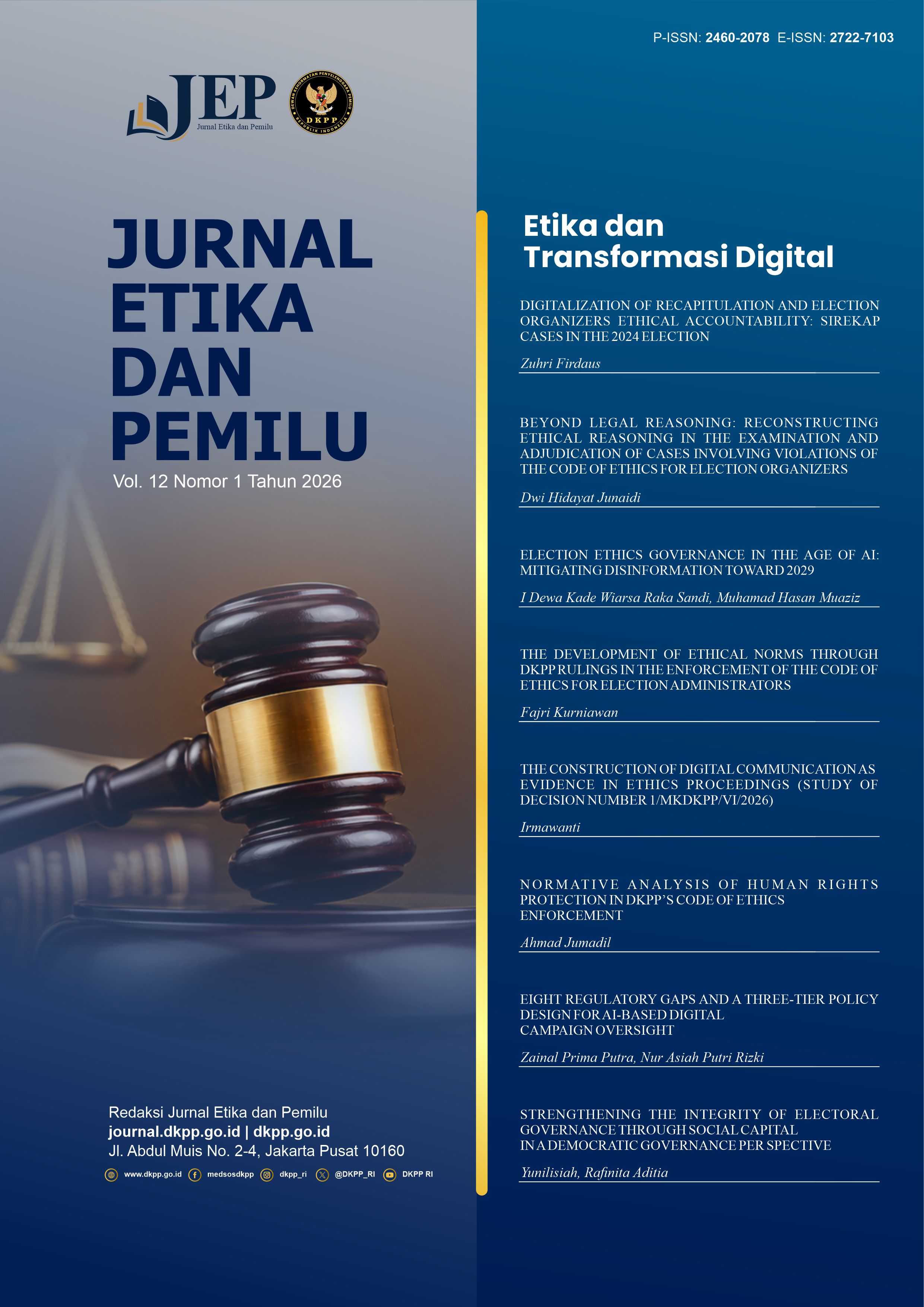
STRENGTHENING THE INTEGRITY OF ELECTORAL GOVERNANCE THROUGH SOCIAL CAPITAL IN A DEMOCRATIC GOVERNANCE PERSPECTIVE
DOI:
https://doi.org/10.68702/etikapemilu.325Keywords:
Electoral Integrity, Social Capital, Democratic Governance, Election Administration, Participatory OversightAbstract
Electoral integrity is essential to democratic legitimacy, yet formal regulations and institutional mechanisms alone do not always ensure ethical, accountable, and publicly trusted election administration. This article examines how social capital strengthens electoral integrity from a democratic governance perspective. A qualitative systematic literature review was conducted using scholarly articles, books, policy documents, and institutional reports published primarily between 2015 and 2026. The data were analyzed through thematic synthesis and a condition–mechanism–outcome framework focusing on bonding, bridging, and linking social capital. The findings show that bonding social capital supports internal solidarity and ethical internalization, bridging social capital expands transparency and participatory oversight, while linking social capital strengthens public access and vertical accountability. These effects operate through trust building, information diffusion, collective coordination, social monitoring, and institutional connectivity. However, social capital may also generate patronage, exclusivity, conflicts of interest, and politicized networks when not supported by institutional independence, transparency, professionalism, and effective oversight. The study concludes that electoral integrity requires a balanced combination of strong institutions and inclusive social relations.
References
Akbar, Muhammad, Muhajir Muhajir, and Hamiyuddin Hamiyuddin. “Optimalisasi Peran Panitia Pemilihan Kecamatan Bahodopi Dalam Meningkatkan Partisipasi Pemilihan Gubernur Dan Wakil Gubernur Tahun 2020.” Qaumiyyah Jurnal Hukum Tata Negara, 2021. https://doi.org/10.24239/qaumiyyah.v2i1.20.
Arun, Sharma, Schwartz Stephen M, and Méndez Eduardo. “Hospital Volume Is Associated With Survival but Not Multimodality Therapy in Medicare Patients With Advanced Head and Neck Cancer.” Cancer, n.d. https://doi.org/10.1002/cncr.27976.
Aspinall, Edward, and Ward Berenschot. Democracy for Sale: Elections, Clientelism, and the State in Indonesia. Ithaca: Cornell University Press, 2019.
Budhiati, Ida. “Rekayasa Sosial Sistem Integritas Penyelenggara Pemilu.” Jurnal Hukum Sasana, 2022. https://doi.org/10.31599/sasana.v8i1.1059.
Fajar, Gilang Aditia, Budi Harjo, and Arizka Warganegara. “Application of the District Magnitude Principle in Determining Electoral Districts and Allocation of Seats (Study at the General Election Commission of Lampung Province).” Qistina Jurnal Multidisiplin Indonesia, 2024. https://doi.org/10.57235/qistina.v3i1.2318.
Haris, Syamsuddin. “Pemilu Dan Partisipasi Politik Masyarakat: Perspektif Demokrasi Deliberatif Di Indonesia.” Jurnal Penelitian Politik LIPI 16, no. 2 (2019): 135–52.
Harnawansyah, M Fadhillah. “Dinamika Politik Daerah Dalam Pelaksanaan Sistem Pemilu Umum Legislatif Daerah.” Syntax Literate Jurnal Ilmiah Indonesia, 2019. https://doi.org/10.36418/syntax-literate.v4i9.710.
Hidayat, R. “Partisipasi Politik Masyarakat Desa Dalam Pengawasan Pemilu Di Daerah Marginal,” 2021.
Hikoyabi, Izak R. “Kemandirian, Integritas, Kapabilitas Dan Partisipatif Di Provinsi Papua Induk Pada Pemilu 2024.” Jurnal Multidisiplin Indonesia, 2023. https://doi.org/10.58344/jmi.v2i3.188.
Illahi, Beni Kurnia. “Desain Ulang Pengaturan Pencegahan Praktik Korupsi Kampanye Dalam Pemilihan Kepala Daerah Oleh Aparatur Sipil Negara.” Jurnal Bawaslu Provinsi Kepulauan Riau, 2020. https://doi.org/10.55108/jbk.v2i1.232.
Imawan, Rafif Pamenang. “Kerangka Evaluasi Pilkada : Evaluasi Pilkada Serentak Melalui Kerangka Integritas Pemilu.” Jurnal Adhyasta Pemilu, 2021. https://doi.org/10.55108/jap.v3i2.16.
International, Transparency. “Corruption Perceptions Index 2023.” Berlin, 2024.
Iqbal, Muhammad. “Integritas Penyelenggara Pemilu Adhoc, Praktik Electoral Fraud Oleh Panitia Pemilihan Di Provinsi Sumatera Utara.” Electoral Governance Jurnal Tata Kelola Pemilu Indonesia, 2020. https://doi.org/10.46874/tkp.v1i2.69.
Ismail, Lukman, Juleha Juleha, Nur Fitriani Rezki. HS, Fasikul Ikhsan, Wahyuddin, and Dicky Wahyudi. “Tinjauan Sosiologis Pemilih Pemula Terhadap Tantangan Transformasi Pemilu 2024.” Aksiologi Jurnal Pendidikan Dan Ilmu Sosial, 2024. https://doi.org/10.47134/aksiologi.v5i1.195.
Kurniawan, D. “Modal Sosial Dan Pengawasan Partisipatif Pada Pemilu Lokal Di Indonesia,” 2022.
Onyemenam, Chris E. “Social Capital and Household Welfare: A Review of Contemporary Empirical Literature.” Journal of Humanities and Social Studies 7, no. 8 (2019). https://doi.org/10.24940/THEIJHSS/2019/V7/I8/HS1908-075.
Putnam, Robert D. “The Prosperous Community: Social Capital and Public Life.” The American Prospect 13, no. 4 (1993): 35–42.
Rahmaddani, Imam. “Tinjauan Yuridis Serta Peran Masyarakat Dan Komisi Pemilihan Umum Dalam Mengatasi Politik Uang (Money Politik) Di Pemilihan Umum.” Supremasi Hukum, 2023. https://doi.org/10.33592/jsh.v18i2.3017.
Rasiana, Rara, Candra Viamita Prakoso, Wahyu Puji Rahayu Ningsih, Siti alikha allyasari, and Oki Pamungkas. “Netralitas Aparatur Sipil Negara Menjelang Pesta Demokrasi 2024.” Jleb Journal of Law Education and Business, 2024. https://doi.org/10.57235/jleb.v2i1.1952.
Sakamoto, Maiko. “The Role of Social Capital in Community Development: Insights from Behavioral Game Theory and Social Network Analysis.” Sustainable Development, 2024. https://doi.org/10.1002/sd.2961.
Salim, Agus, and Asip Suyadi. “Hak Politik Individual Pra Dan Pasca Menjadi Narapidana Dalam Sistem Ketatanegaraan.” Rechtsregel Jurnal Ilmu Hukum, 2020. https://doi.org/10.32493/rjih.v3i1.6617.
Saputra, Ade Rizki, Mira Gunati, Miliyandra Miliyandra, Ery Rachma Firsanti, and Tri Agus Haryono. “Legal Politics in the 2024 Election Era in Indonesia.” Formosa Journal of Sustainable Research, 2024. https://doi.org/10.55927/fjsr.v3i5.9074.
Ukas, Razaki Persada, and Zuhdi Arman. “Penegakan Kode Etik Penyelenggara Pemilu Berdasarkan Undang-Undang Nomor 15 Tahun 2011 Pada Pemilu Anggota DPR, DPD Dan DPRD Di Provinsi Kepulauan Riau.” Jurnal Hukum Samudra Keadilan, 2020. https://doi.org/10.33059/jhsk.v15i1.2104.
Wahyuni, S. “Modal Sosial Dan Partisipasi Politik Masyarakat Perdesaan Pada Pemilu Di Indonesia,” 2021.
Waruwu, Desrina, Helmi Dewi Sri Hombing, Sanny Elysa Situmorang, and Sutri Destemi Elsi. “Analisis Peran Teknologi Digital Pada Proses Pelaksanaan Pemilu Serentak 2024.” Journal of Law Administration and Social Science, 2024. https://doi.org/10.54957/jolas.v4i5.887.
Woolcock, Michael. Social Capital and Development: Toward a Theoretical Synthesis and Policy Framework. Washington DC: World Bank, 2001.
Yunilisiah, Tamrin Bangsu, and Desy Afrita. “Socıal Capıtal To Implement The Socıal Functıonalıty Of Transmıgrant Communıtıes Based On Land Tenure Patterns In.” Asian Journal of Management Entrepreneurship and Social Science 04, no. 03 (2024): 1721–31.
Downloads
Published
Issue
Section
License
License Terms
1. Copyright Policy
Authors who publish with Jurnal Etika dan Pemilu retain the copyright to their work. By submitting a manuscript, authors grant the journal the right of first publication, with the work simultaneously licensed under a Creative Commons Attribution-NonCommercial 4.0 International License (CC BY-NC 4.0).
2. Creative Commons Attribution-NonCommercial 4.0 (CC BY-NC 4.0)
This license allows others to:
-
Share: Copy and redistribute the material in any medium or format.
-
Adapt: Remix, transform, and build upon the material.
Under the following terms:
-
Attribution: You must give appropriate credit, provide a link to the license, and indicate if changes were made. You may do so in any reasonable manner, but not in any way that suggests the licensor endorses you or your use.
-
NonCommercial: You may not use the material for commercial purposes.
3. Author Rights
Authors retain the right to:
-
Archive their own articles in institutional or subject-based repositories (such as university websites).
-
Use their articles in their own future work, including lectures, books, or personal compilations.
-
Retain intellectual property rights without restrictions, provided that the original publication in Jurnal Etika dan Pemilu is properly cited.
4. User Responsibilities
Users of the journal website must comply with the following:
-
Any redistribution of published content must include a clear citation of the original article, including the author’s name, the title of the article, the journal name, the volume/issue number, and the DOI link.
-
Commercial reproduction or distribution of any content published in this journal is strictly prohibited without the express written permission of the copyright holder (the author) and the journal publisher (DKPP).
5. Third-Party Content
Some materials (such as images, tables, or data sets) published within an article may be subject to third-party copyright. It is the responsibility of the author to ensure that all necessary permissions have been obtained for the inclusion of such materials prior to submission.