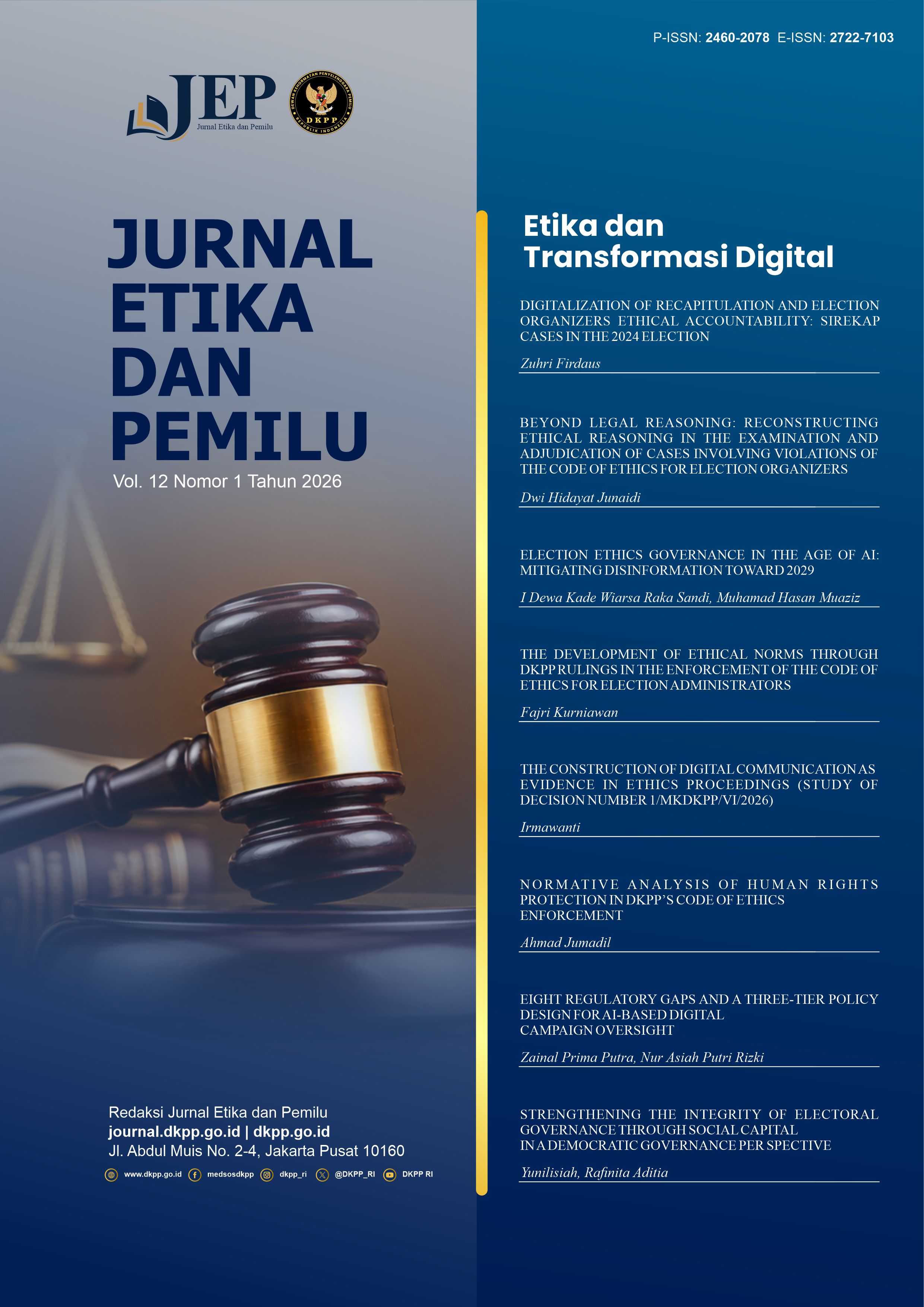
ELECTION ETHICS GOVERNANCE IN THE AGE OF AI: MITIGATING DISINFORMATION TOWARD 2029
DOI:
https://doi.org/10.68702/etikapemilu.347Keywords:
Disinformation, Artificial Intelligence, Ethics of Election Administrators, Electoral Integrity, Electoral GovernanceAbstract
The era of generative artificial intelligence (AI) introduces a cheap, fast, and easily personalised threat of electoral disinformation ahead of Indonesia's 2029 General Election, even as its legal, institutional, and ethical frameworks remain ad hoc and reactive. This paper maps the typology of AI-based disinformation risks and emerging ethical issues for election administrators, assesses the adequacy of the existing framework, and formulates realistic, anticipatory options for strengthening governance before 2029. It employs a qualitative, legal-normative, and policy-analysis approach, drawing on legislation, DKPP complaint and hearing data for 2024–2026, national and international policy documents, and 2026 focus group discussions with electoral stakeholders. The findings show that electoral disinformation has shifted from manually produced hoaxes toward content produced and orchestrated by generative AI, while existing legal instruments remain scattered without clear integration. Five new categories of ethical risk for election administrators are identified, alongside reform opportunities through Constitutional Court Ruling No. 166/PUU-XXI/2023, the Election Bill's legislative agenda, and the finalisation of national AI policy. The paper concludes with five governance-strengthening options as anticipatory measures ahead of the 2029 electoral process.
References
Agim, Moh, Ramli Mahmud, Saleh Al Hamid. Strategi Pengawasan Panitia Pengawa Kecamatan Pada Pelaksanaan Pemilihan Umum Tahun 2024 Di Kecamatan Moutong Kabupaten Parigi Moutong. Al-Zayn: Jurnal Ilmu Sosial&Hukum, Vol 4 No. 2, 2026. H.4363. https://doi.org/10.61104/alz.v4i2.4909
Andini, Yunita. Kepercayaan Masyarakat pada Komisi Pemilihan Umum (KPU) Kota Palembang (Studi Kasus Kecamatan Ilir Timur II, Gandus, Jakabaring. Ampera: A Research Journal on Politic and Islamic Civilization. Vol. 1 No. 1 Januari 2020.
Asrulla, Ahmad Syukri, Maryani, Firdaus Jeka, Roni Junaidi, Konsepsi Etika, Moral, dan Ilmu Pengetahuan dalam Perspektif Humanism, Jurnal Genta Mulia, Vol 15 No 2. 2024. https://ejournal.stkipbbm.ac.id/index.php/gm
Asshiddiqie, J. (2014). Peradilan etik dan etika konstitusi: Perspektif baru tentang rule of law and rule of ethics. Sinar Grafika.
Asshiddiqie, J. (2015). Menegakkan etika penyelenggara pemilu (Cet. ke-2). PT RajaGrafindo Persada.
Azmi, M. A. P., Bima, M. R., & Muin, S. A. (2026). Dilema deepfake: Menimbang tanggung jawab pidana melawan erosi integritas pemilihan umum. Legal Dialogica, 1(2).
Coombs, 2010, dalam Rachmat Kriyantono, Yuyun Agus Riani, Rizky Ika Safitri, Public Attributin vs Punitive Behavior in Indonesian Public Relations Practice, Jurnal Ilmu Komunikasi, Vol 14 No. 1 Juni 2017.
Dahl, R. A. (1971). Polyarchy: Participation and opposition. Yale University Press.
Dewan Kehormatan Penyelenggara Pemilu Republik Indonesia. (2017). Laporan lima tahun DKPP 2012–2017. Sekretariat DKPP.
Dewan Kehormatan Penyelenggara Pemilu Republik Indonesia. (2026). Rekapitulasi data pengaduan dan persidangan Desember 2024–Desember 2025 [Data internal]. DKPP RI.
Dewi, Lia Riesta, Maya Sri Novita. Etika Penyelenggara Pemilu Dalam Pelaksanaan Pilkada Serentak Tahun 2024, Yustisia Tirtayasa, Vol. 5 no 2, April-June 2025. http://dx.doi.org/10.51825/yta.v5i2.29343
Kofi Annan Foundation. (n.d.), Electoral Integrity Initiative. Diakses 25 Juli 2026, dari https://www.kofiannanfoundation.org/elections-democracy/electoral-integrity-initiative/
Kofi Annan Foundation. (n.d.). Electoral integrity initiative. Diakses 25 Juli 2026, dari https://www.kofiannanfoundation.org/elections-democracy/electoral-integrity-initiative/
Komisi Pemilihan Umum Filipina (COMELEC). (2025). Ketentuan penggunaan media sosial, kecerdasan artifisial, dan teknologi internet dalam kampanye pemilu 2025.
Labuz, Mateusz, Christopher Nehring, On The Way To Deep Fake Democracy? Deep Fake In Election Campaigns In 2023, European Political Science (2024), https://doi.org/10.1057/s41304-024-00482-9
Lasni Sutri, Siti Sumartini, Uswatun Hasanah, Mengelola Risiko dan Etika Pemanfaatan Artificial Intelligence (AI) Dalam Pembelajaran Di Sekolah Dasar, Journal Of Innovative And Creativity, Vol 5 No. 3. 2025.
Librianti, E. O. I. (2025). Deepfake dalam komunikasi politik: Tantangan etika dan aspek hukum dalam era artificial intelligence. Siyasah: Jurnal Hukum Tata Negara, 5(2), 221–238.
Lusy Asa Akhrani, Fitsabilla Imansari, Faizah, Kepercayaan Politik dan Partisipasi Politik Pemilih Pemula, Mediapsi, Vol 4. No. 1. https://doi.org/10.21776/ub.mps.2018.004.01.1
Mahkamah Konstitusi Republik Indonesia. Putusan Nomor 166/PUU-XXI/2023. (2023).
Marcineck, Krystyna, Karlyn D. Stanley, Gregory Smith, Paul Cormarie, Salil Gunashekar, Risk-Based AI Regulation: A Primer on the Artificial Intelligence Act of the European Union, Research November 2024. https://www.rand.org/pubs/research_reports/RRA3243-3.html
Nasution, Bahder Johan. Metode Penelitian Ilmu Hukum. (Bandung: Mandar Maju. 2008).
O Marko, Jhon Gabriel, Ciprian Daniel Neagu, P.B. Anand, Examining Inclusivity: The Use of AI And Diverse Populations In Health and Social Care: A Systematic Review. BMC Medical Informatic and Decision Making. (2025) 25:57. https://doi.org/10.1186/s12911-025-02884-1
Peraturan Dewan Kehormatan Penyelenggara Pemilihan Umum Nomor 2 Tahun 2017 tentang Kode Etik dan Pedoman Perilaku Penyelenggara Pemilu.
Peraturan Dewan Kehormatan Penyelenggara Pemilihan Umum Nomor 3 Tahun 2017 tentang Pedoman Beracara Kode Etik Penyelenggara Pemilihan Umum, sebagaimana diubah dengan Peraturan DKPP Nomor 1 Tahun 2021.
Peraturan DKPP Nomor 5 Tahun 2017 tentang Tim Pemeriksa Daerah, sebagaimana diubah dengan Peraturan DKPP Nomor 1 Tahun 2019.
Rahmadhani, Adera. Membangun Budaya Integritas Dalam Dunian Pendidikan dan Organisasi, Global Research And Innovation Journal (GREAT), Vol 1 No. 3, 2025. https://journaledutech.com/index.php/great
Raka Sandi, I. D. K. W. Penguatan tata kelola pemilu di era AI: Menghadapi ancaman disinformasi berbasis artificial intelligence menjelang Pemilu 2029 [Bahan kebijakan/presentasi]. Dewan Kehormatan Penyelenggara Pemilu RI. (2026).
Ramadhan, K. Z., & Sugama, I. D. G. D. (2024). Penegakan hukum terhadap penggunaan teknologi AI: Teknik deepfake dalam penyelenggaraan pemilu. Kertha Desa, 12(5), 4514–4528.
Samsuar, Atribusi, Jurnal Network Media Vol 2 No. 1 Februari 2019.
Sandi, Idewa Kade Wiarsa Raka, dkk. Etika Yang Melembaga: 70 Tahun Prof. Jimly Asshiddiqie Warisan Gagasan Dan Penguatan DKPP, (Jakarta: Sinar Grafika)
Schipper, Tetiana, Disinformation By Design: Leveraging Solutions To Combat Misinformation in the Philipines’ 2025 Election, Data & Policy, Vol 7, e39, 2025. https://doi.org/10.1017/dap.2025.18
Sukmawan, Yulia Audia, Dwi Damayanti, Metode Penelitian Hukum Normatif dan Empiris Sebagai Strategi Penguatan Perspektif Kajian Ilmu Hukum, NoLaj, Vol 4 No. 1 July-September 2025. https://notarylaw.journal.ulm.ac.id/index.php/nolaj
Sumaryanto, A. Djoko, Naufal Noumi Adam. P, Cut Fadhlan Akhyar, Nurhayati Jafar, Bangun Batrianto. Penerapan Hukum Terhadap Penyebar Hoaks Berbasis AI (AI-Generated Misinformation), UNES Law Review, Vol 8 No. 4 Juni 2026. https://doi.org/10.31933/vt8h2m31
Syaefudin, Muhammad, Kadi Sukarna. Kewenangan Dewan Kehormatan Penyelenggara Pemilu (DKPP) dalam Menegakan Kode Etik Pelanggaran Pemilihan Umum, Jurnal USM Law Review Vol. 1 No. 2 Tahun 2018.
Undang-Undang Dasar Negara Republik Indonesia Tahun 1945.
Undang-Undang Nomor 7 Tahun 2017 tentang Pemilihan Umum.
Uni Eropa. Regulasi Kecerdasan Artifisial Berbasis Risiko Untuk Sistem Yang Memengaruhi Proses Demokrasi (EU AI Act). (2024).
Wijanarko, Pendi. Tantangan Integritas Pemilu di Tengah Kemajuan Artificial Inellegence. 17 Mei 2026, https://www.kpu.go.id/berita/baca/13661/tantangan-integritas-pemilu-di-tengah-kemajuan-artificial-intelligence.
Wilde, Aisya Avrylia Elskan, Hery Firmansyah, Kelemahan Penanganan Pelanggaran Tindak Pidana Pemilihan Umum Di Negara Republik Indonesia, Unes Law Review, Vol. 6 No.4, Juni 2024. https://doi.org/10.31933/unesrev.v6i4
World Economic Forum. Global risks report 2024. World Economic Forum. (2024).
Downloads
Published
Issue
Section
License
License Terms
1. Copyright Policy
Authors who publish with Jurnal Etika dan Pemilu retain the copyright to their work. By submitting a manuscript, authors grant the journal the right of first publication, with the work simultaneously licensed under a Creative Commons Attribution-NonCommercial 4.0 International License (CC BY-NC 4.0).
2. Creative Commons Attribution-NonCommercial 4.0 (CC BY-NC 4.0)
This license allows others to:
-
Share: Copy and redistribute the material in any medium or format.
-
Adapt: Remix, transform, and build upon the material.
Under the following terms:
-
Attribution: You must give appropriate credit, provide a link to the license, and indicate if changes were made. You may do so in any reasonable manner, but not in any way that suggests the licensor endorses you or your use.
-
NonCommercial: You may not use the material for commercial purposes.
3. Author Rights
Authors retain the right to:
-
Archive their own articles in institutional or subject-based repositories (such as university websites).
-
Use their articles in their own future work, including lectures, books, or personal compilations.
-
Retain intellectual property rights without restrictions, provided that the original publication in Jurnal Etika dan Pemilu is properly cited.
4. User Responsibilities
Users of the journal website must comply with the following:
-
Any redistribution of published content must include a clear citation of the original article, including the author’s name, the title of the article, the journal name, the volume/issue number, and the DOI link.
-
Commercial reproduction or distribution of any content published in this journal is strictly prohibited without the express written permission of the copyright holder (the author) and the journal publisher (DKPP).
5. Third-Party Content
Some materials (such as images, tables, or data sets) published within an article may be subject to third-party copyright. It is the responsibility of the author to ensure that all necessary permissions have been obtained for the inclusion of such materials prior to submission.