
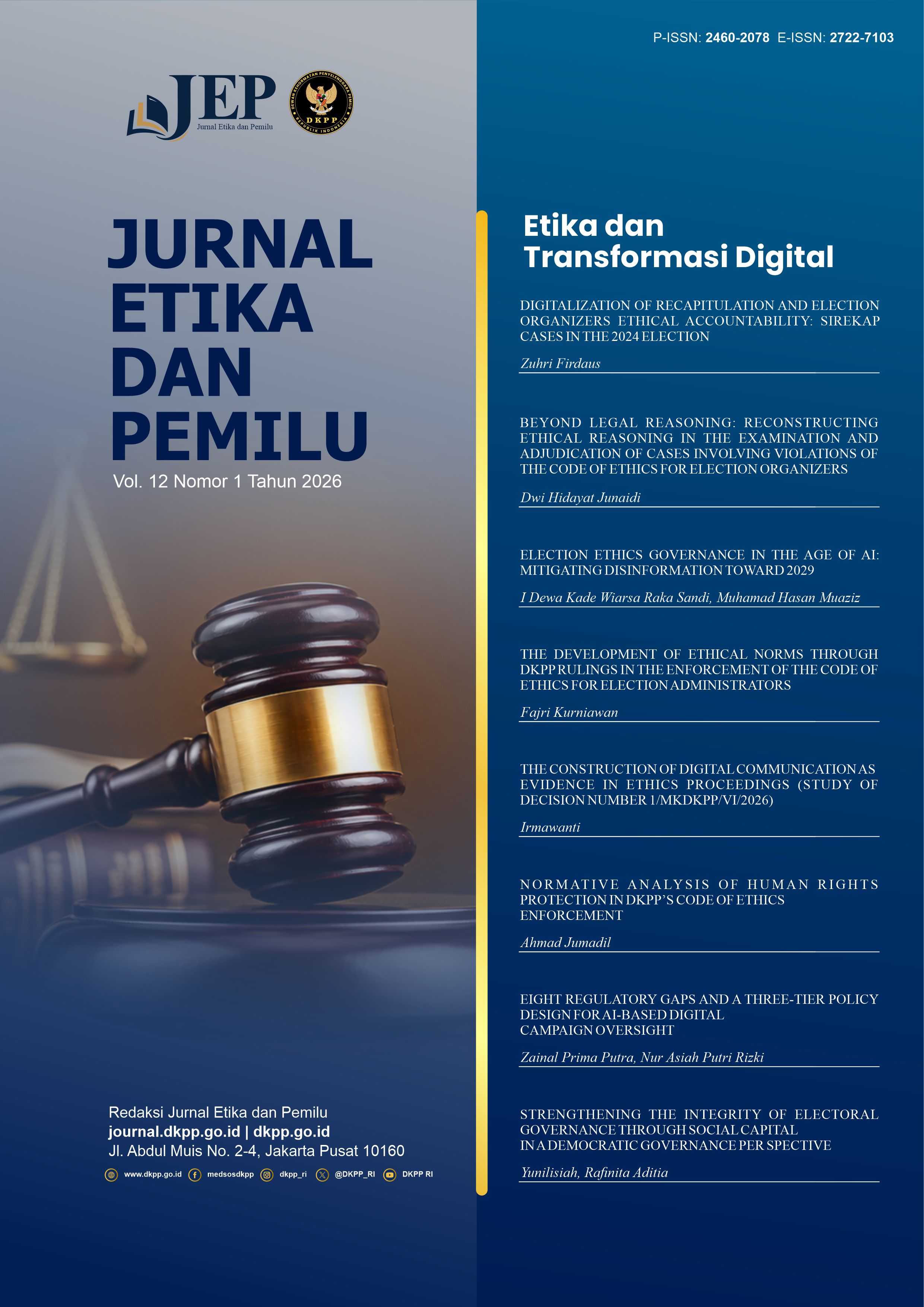
THE CONSTRUCTION OF DIGITAL COMMUNICATION AS EVIDENCE IN ETHICS PROCEEDINGS (STUDY OF DECISION NUMBER 1/MKDKPP/VI/2026)
DOI:
https://doi.org/10.68702/etikapemilu.350Keywords:
digital communication, legal communication, representation, DKPP Decision, MKDKPPAbstract
The evolution of digital communication in election administration has generated communication records that serve purposes beyond mere administration and coordination; they can also be utilized to examine alleged ethical violations by election officials. This is evident in the DKPP Ethics Council Decision Number 1/MKDKPP/VI/2026, which incorporates WhatsApp exchanges regarding information dissemination, coordination, event schedules, and operational details. This study aims to reveal how digital communication is represented, interpreted, and constructed as factual evidence during the examination of ethical violations by election officials. Adopting a qualitative approach, the study employs directed qualitative content analysis and utilizes Stuart Hall’s theory of representation as its analytical framework. The research data consists of the text of DKPP Decision Number 1/MKDKPP/VI/2026, with coding focused on context, selection, placement, interpretation, recontextualization, and the construction of facts. The findings indicate that digital communication undergoes a functional transformation when it shifts from interpersonal or administrative interaction to an ethics inquiry. Messages that originally served as tools for information and coordination are represented within the case narrative and positioned alongside other testimonies and documents. They are subsequently interpreted through the lenses of propriety, appropriateness, professionalism, and the accountability of election officials. In conclusion, digital communication constitutes a text capable of undergoing semantic transformation and plays a pivotal role in constructing ethical facts during the examination process of election officials.
References
BUKU
Hall, Stuart, Jessica Evans, and Sean Nixon. Representation. Edited by Mila Steele. 2nd ed. United Kingdom: Sage Publications, 2013. https://archive.org/details/representationO00Ounse_p0d2_2ed.
Nasution, S. Metode Penelitian Naturalistik Kualitatif. Jakarta: Tarsito, 2003.
Putri, Shely Natasya, and Firmansyah. Komunikasi Hukum. Edited by Fredy Gandhi Midia. 1st ed. Solok: Cendekia Muslim, 2023.
Schreier, Margrit. Margrit Schreier Qualitative Content Analysis in Practice Qualitative Content Analysis in Practice, 2012. www.sagepub.co.uk/schreier.
Shava, G N, S Hleza, F Tlou, S Shonhiwa, and E Mathonsi. “Qualitative Content Analysis, Utility, Usability and Processes in Educational Research.” International Journal of Research and Innovation in Social Science V (July 2021): 2454–6186. www.rsisinternational.org.
JURNAL
Adityatjahja, Anung. “Komunikasi Hukum Dalam Perkara Pidana Dan Perdata: Kajian Pustaka Tentang Komunikasi Lisan, Tertulis, Elektronik, Dan Digital Sebagai Alat Bukti.” Jurnal Komunikasi 4, no. 2 (2026): 60–70. https://ecosemica.net/index.php/KOMUNIKASI.
Aryana, Andi Nadia, Muh Akbar, Muhammad Farid, and Alem Febri Sonni. “Digital Forensics and Legal Communication: Network Analysis of Law Enforcement Response to Viral Youth Violence Cases in Indonesia.” Frontiers in Human Dynamics 8 (2026). doi:10.3389/fhumd.2026.1709823.
Asari, Andi, Efa Rubawanti Syaifuddin, Nurfitria Ningsi, Sudianto, Hana Diana Maria, Iwab Adhicandra, Rini Nuraini, and Achmad Baijuri. Komunikasi Digital. 1st ed. Klaten: Lakeisha, 2023.
Fitriati, Meita Lefi Kurnia, and Fitra Oktoriny. “APLIKASI KOMUNIKASI HUKUM SEBAGAI USAHA PENEGAKAN HUKUM DI DAERAH MARJINAL.” Masalah-Masalah Hukum 43 (2014): 560–67.
Gusfa, Henni, Elly Yuliawati, and Irmawanti. “Modelisasi_komunikasi_konstitutif_Dewan_Kehormatan,” 2019.
Hardyansah, Rommy, and Rio Saputra. “Convergence and Divergence: Strategies for Convergence and Divergence: Strategies for Proving Digital Evidence in Common Law and Indonesian Law Systems.” Jurnal Daulat Hukum 9, no. 1 (March 2026). https://jurnal.unissula.ac.id/index.php/RH/article/view/51432/15693.
Hasfi, Nurul. KOMUNIKASI POLITIK DI ERA DIGITAL. Jurnal Ilmu Politik. Vol. 10, 2019.
Nasution, Kapsan Usman Utomo. “Peran Tokoh Adat Sebagai Agen Komunikasi Hukum Di Mandailing Natal.” Neoclassical Legal Review: Journal of Law and Contemporary Issues 3, no. 1 (May 12, 2024): 12–20. doi:10.32734/nlr.v3i1.15530.
UNDANG-UNDANG
Pemerintah Pusat. Undang-undang Nomor 11 Tahun 2008 Tentang Informasi dan Transaksi Elektronik, Pub. L. No. 11 tahun 2008 (2008).
WEBSITE
DKPP RI. Putusan Nomor: 1/MKDKPP/VI/2026, Pub. L. No. 1/MKDKPP/VI/2026 (2026). https://dkpp.go.id/putusan/.
Humas DKPP. “DKPP Komitmen Tegakkan KEPP.” Https://Dkpp.Go.Id/Dkpp-Komitmen-Tegakkan-Kepp/, July 29, 2026.
Downloads
Published
Issue
Section
License
License Terms
1. Copyright Policy
Authors who publish with Jurnal Etika dan Pemilu retain the copyright to their work. By submitting a manuscript, authors grant the journal the right of first publication, with the work simultaneously licensed under a Creative Commons Attribution-NonCommercial 4.0 International License (CC BY-NC 4.0).
2. Creative Commons Attribution-NonCommercial 4.0 (CC BY-NC 4.0)
This license allows others to:
-
Share: Copy and redistribute the material in any medium or format.
-
Adapt: Remix, transform, and build upon the material.
Under the following terms:
-
Attribution: You must give appropriate credit, provide a link to the license, and indicate if changes were made. You may do so in any reasonable manner, but not in any way that suggests the licensor endorses you or your use.
-
NonCommercial: You may not use the material for commercial purposes.
3. Author Rights
Authors retain the right to:
-
Archive their own articles in institutional or subject-based repositories (such as university websites).
-
Use their articles in their own future work, including lectures, books, or personal compilations.
-
Retain intellectual property rights without restrictions, provided that the original publication in Jurnal Etika dan Pemilu is properly cited.
4. User Responsibilities
Users of the journal website must comply with the following:
-
Any redistribution of published content must include a clear citation of the original article, including the author’s name, the title of the article, the journal name, the volume/issue number, and the DOI link.
-
Commercial reproduction or distribution of any content published in this journal is strictly prohibited without the express written permission of the copyright holder (the author) and the journal publisher (DKPP).
5. Third-Party Content
Some materials (such as images, tables, or data sets) published within an article may be subject to third-party copyright. It is the responsibility of the author to ensure that all necessary permissions have been obtained for the inclusion of such materials prior to submission.