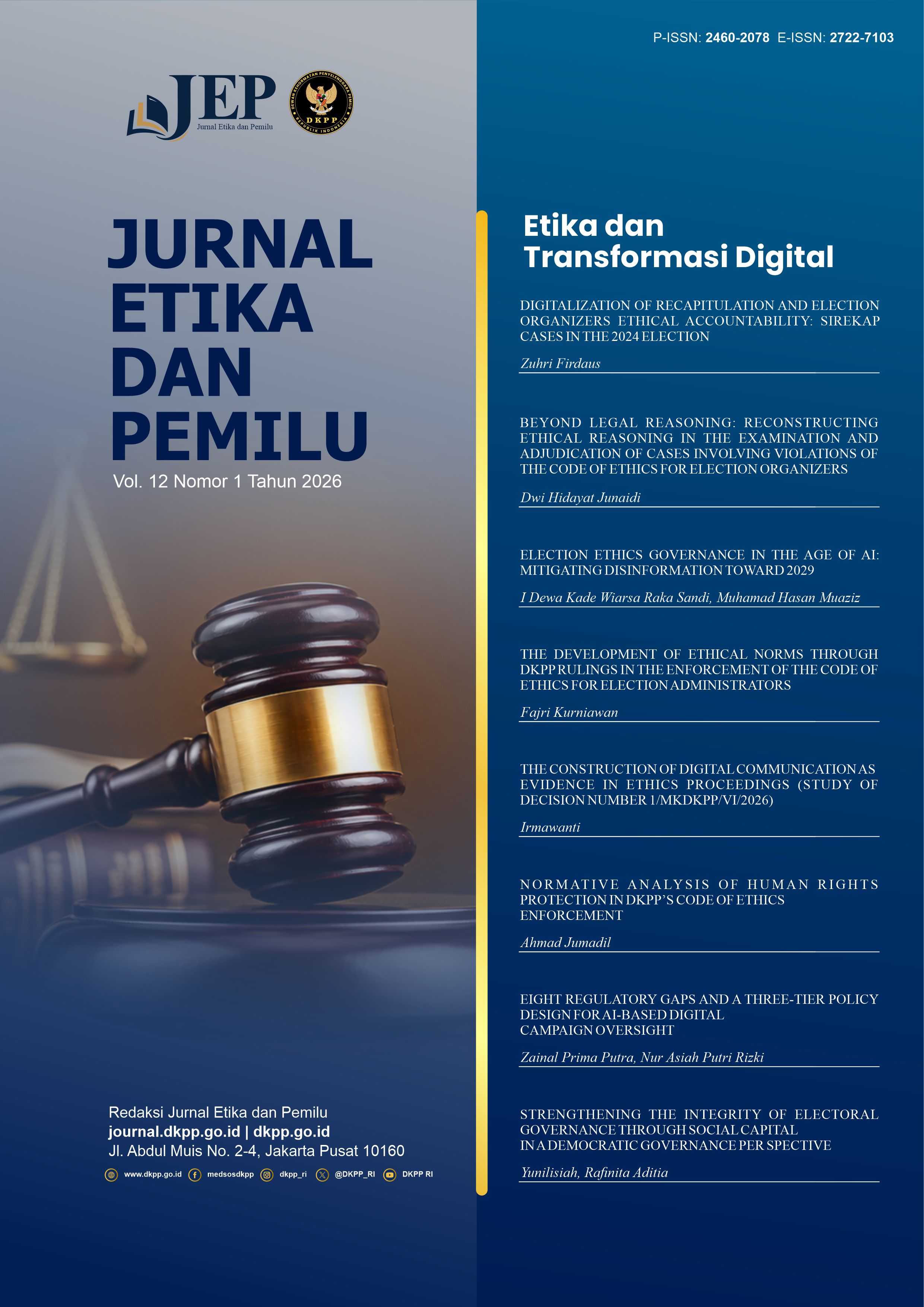
THE DEVELOPMENT OF ETHICAL NORMS THROUGH DKPPRULINGS IN THE ENFORCEMENT OF THE CODE OF ETHICS FORELECTION ADMINISTRATORS
DOI:
https://doi.org/10.68702/etikapemilu.352Keywords:
DKPP Rulings, Ethical Norms, ElectionsAbstract
The evolution of election administration has given rise to increasingly diverse forms of ethical violations, while the code of ethics for election administrators does not always comprehensively regulate every behavior encountered in practice. This situation places the Election Organizer Ethics Council (DKPP) in a pivotal role regarding the interpretation and concretization of ethical norms through its rulings. This research addresses how ethical norms evolve through DKPP rulings and identify the parameters that allow such norms to serve as a basis for refining the code of ethics for election administrators. The study employs a normative (doctrinal) legal research method, utilizing statutory, conceptual, and case-based approaches. Legal materials were analyzed qualitatively by examining DKPP rulings issued in 2026 to identify reasoning patterns and the evolution of ethical standards. The findings indicate that ethical norms evolve through the interpretation of code-of-ethics principles considering concrete facts. One notable development is the expansion of standards regarding the abuse of authority to include a prohibition on exploiting power dynamics for personal gain. Evolving ethical norms can serve as a basis for refining the code of ethics provided, they meet specific parameters: consistency, recurrence, clarity, general applicability, and alignment with the code’s fundamental principles. Consequently, periodic inventory and evaluation of DKPP rulings are necessary to identify consistently evolving norms and to codify them within the refined code of ethics.
References
Agus Dwiyanto, Pemerintah yang Baik, Tanggap, Efisien dan Akuntabel, Kontrol Atau Etika Forum Kebijakan Publik, (Yogyakarta: Pascasarjana UGM, 2000)
Agussyah Ramadani Damanik, “Pengujian Putusan Kode Etik Penyelenggara Pemilu dalam Ranah Hukum Administrasi Negara”, Jurnal Normatif 4, no. 2 (2024), DOI: https://doi.org/10.54123/jn.v4i2.396
Akhmad Mukhlis, “DKPP’S Position As a Legally Contained Ethics Enforcer”, Jurnal Etika dan Pemilu 11, no.1 (2025), URL: https://journal.dkpp.go.id/index.php/etikapemilu/article/view/308
Bambang Sadono, et.al., Checks And Balances Dalam Sistem Ketatanegaraan Indonesia, (Jakarta: Badan Pengkajian MPR RI, 2017)
Bintang Adi Putra, et.al, “Metodologi Penelitian Hukum Normatif dalam Perspektif Konsep dan Teknik Analisis dalam Kajian Yuridis”, Jurnal Kajian Ilmiah Multidisipliner 10, no. 4 (2016), https://sejurnal.com/pub/index.php/jkim/article/view/915
Fajri Kurniawan, M. Naufal Al-Hadi Kasuma, “Code of Ethics and Election Integrity: Measuring The Authority of The DKPP In Enforcement of Indonesian Elections”, Jurnal Etika dan Pemilu 11, no. 1 (2025), URL: https://journal.dkpp.go.id/index.php/etikapemilu/article/view/299
Fritz Edward Siregar, Dimensi Hukum Pelanggaran Administrasi Pemilu, (Jakarta: Konstitusi Press, 2020)
Gunawan Suswantoro, Pengawasan Pemilu Partisipatif, (Jakarta: Erlangga, 2015)
Harmoko M. Said, “Kedudukan Dewan Kehormatan Penyelenggara Pemilu Sebagai Lembaga Quasi Peradilan Etik,” Jurnal Fundamental 10, no. 2 (2021), URL: https://garuda.kemdiktisaintek.go.id/documents/detail/4862645
International IDEA, Electoral Justice: An Overview of the International IDEA Handbook, (Jakarta: Indonesia Printer, 2010)
Khairul Fahmi, Desip Trinanda, Ilhamdi Putra, “Kemandirian dan Profesionalitas Penyelenggara Pemilu: Analisis Putusan DKPP terhadap Penyelenggara Pemilu di Sumatera Barat Tahun 2013-2024”, Jurnal Konstitusi 23, no. 2 (2026), DOI: https://doi.org/10.31078/jk2324
___________, Pemilihan Umum dalam Transisi Demokrasi, (Jakarta: PT RajaGrafindo Persada, 2016)
M. Iqbal Hasan, Pokok-Pokok Materi Metodologi Penelitian dan Aplikasinya, (Jakarta: Ghalia Indonesia, 2002)
Mahkamah Konstitusi, “Pejabat Negara Kampanye Berpotensi Konflik Kepentingan”, Mahkamah Konstitusi, https://www.mkri.id/berita/pejabat-negara-kampanye-berpotensi-konflik-kepentingan-19887
Masykurudin Hafidz, et.al., Desain Pengawasan Pemilihan Serentak, (Jakarta: Bawaslu, 2020)
Muhammad Asrun, Hukum Acara Sengketa Pemilu Mahkamah Republik Indonesia, (Depok: RajaGrafindo Persada, 2020)
Muhammad Nur Ramadhan, “Eksistensi Gugatan Tata Usaha Negara Terhadap Keputusan Tindak Lanjut Putusan Dewan Kehormatan Penyelenggara Pemilihan Umum,” Jurnal Bawaslu Provinsi Kepulauan Riau 4, no. 1 (2022)
Muhammad, Teguh Prasetyo, Eksistensi DKPP RI dalam Mengawal Demokrasi dan Pemilu Bermartabat, (Depok: RajaGrafindo Persada, 2018)
Nur M. Kasim, Erman Rahim, Supriyadi A Arief, “Main Mata Penyelenggara Pemilu: Menjunjung Integritas Dan Upaya Menegakan Hukum”, Konferensi Nasional Asosiasi Pengajar Hukum Tata Negara dan Hukum Administrasi Negara 1, no. 1 (2023), DOI: https://doi.org/10.55292/hb7fge58
Peraturan DKPP Nomor 2 Tahun 2017 tentang Kode Etik dan Pedoman Perilaku Penyelenggara Pemilihan Umum
Peraturan DKPP Nomor 3 Tahun 2017 tentang Pedoman Beracara Kode Etik Penyelenggara Pemilihan Umum
Peter Mahmud Marzuki, Penelitian Hukum, (Jakarta: Kencana Prenada Media Group, 2010)
Ratih Pandan Sari,” Etika sebagai Fondasi Integritas Penyelenggara Pemilu dalam Mewujudkan Demokrasi yang Berkepercayaan”, Majelis: Jurnal Hukum Indonesia 3, no. 3 (2026), DOI: https://doi.org/10.62383/majelis.v3i3.1861
Rian Adhivira Prabowo, Etika yang Melembaga 70 Tahun Prof. Jimly Asshiddiqie Warisan Gagasan dan Penguatan DKPP, (Jakarta: Sinar Grafika, 2026)
Robiyan Arifin, “Etika Penyelenggara Pemilu”, KPU Kota Surabaya, https://kota-surabaya.kpu.go.id/blog/read/etika-penyelenggara-pemilu
Saleh, Hukum Acara Sidang Etik Penyelenggara Pemilu, (Jakarta: Sinar Grafika, 2017)
Sandy Ari Wijaya, Widya Hartati, “Analisis Hukum Putusan Dewan Kehormatan Penyelenggara Pemilihan Umum dalam Pelanggaran Kode Etik Penyelenggara Pemilu di Kabupaten Lombok Timur Tahun 2024 (Studi Kasus Perkara Nomor 187-PKE-DKPP/VIII/2024)”, Referendum: Jurnal Hukum Perdata dan Pidana 2, no. 2 (2025), DOI: https://doi.org/10.62383/referendum.v2i2.732
Siti Hamimah, Rengga Kusuma Putra, “Model Penanganan Pelanggaran Kode Etik Penyelenggara Pemilu di Kabupaten Karawang”, Demokrasi: Jurnal Riset Ilmu Hukum, Sosial dan Politik 1, no. 4 (2024), DOI: https://doi.org/10.62383/demokrasi.v1i4.645
Soerjono Soekanto, Pengantar Penelitian Hukum, (Depok: Universitas Indonesia Press, 2008)
Susi Dwi Harijanti, Menggagas Peradilan Etik di Indonesia, (Jakarta: Sekretariat Jenderal Komisi Yudisial Republik Indonesia, 2015)
Syopiansyah Jaya Putra, et.al., Outlook 2016: Refleksi dan Proyeksi, (Jakarta: DKPP RI, 2016)
Teguh Prasetyo, DKPP Penegak Etik Penyelenggara Pemilu Bermartabat, (Depok: RajaGrafindo Persada, 2018)
Tria Noviantika, “Gagasan Peradilan Etik: Penataan Kelembagaan Penegakan Kode Etik Penyelenggara Negara”, (Tesis, Universitas Gadjah Mada, 2024)
Umi Khairiah, Jaurinawi Tanjuaang, “Relevansi Kepastian Hukum dalam Mewujudkan Keadilan Pada Sistem Peradilan Indonesia”, Jurnal Normatif 5, no. 2 (2025), DOI: https://doi.org/10.54123/jn.v5i2.489
Undang-Undang Nomor 7 Tahun 2017 tentang Pemilihan Umum
Yulia Audina Sukmawan dan Dwi Damayanti, “Metode Penelitian Hukum Normatif dan Empiris sebagai Strategi Penguatan Perspektif Kajian Ilmu Hukum”. Notary Law Journal 4, no. 3 (2025), https://notarylaw.journal.ulm.ac.id/index.php/nolaj/article/view/116
Zulfikhar, “Menakar Potensi Pelanggaran Kode Etik Penyelenggara Pemilu: Sebuah Analisis Teori Strukturasi”, Electoral Governance Jurnal Tata Kelola Pemilu Indonesia 5, no. 1 (2023), DOI: https://doi.org/10.46874/tkp.v5i1.1076
Downloads
Published
Issue
Section
License
License Terms
1. Copyright Policy
Authors who publish with Jurnal Etika dan Pemilu retain the copyright to their work. By submitting a manuscript, authors grant the journal the right of first publication, with the work simultaneously licensed under a Creative Commons Attribution-NonCommercial 4.0 International License (CC BY-NC 4.0).
2. Creative Commons Attribution-NonCommercial 4.0 (CC BY-NC 4.0)
This license allows others to:
-
Share: Copy and redistribute the material in any medium or format.
-
Adapt: Remix, transform, and build upon the material.
Under the following terms:
-
Attribution: You must give appropriate credit, provide a link to the license, and indicate if changes were made. You may do so in any reasonable manner, but not in any way that suggests the licensor endorses you or your use.
-
NonCommercial: You may not use the material for commercial purposes.
3. Author Rights
Authors retain the right to:
-
Archive their own articles in institutional or subject-based repositories (such as university websites).
-
Use their articles in their own future work, including lectures, books, or personal compilations.
-
Retain intellectual property rights without restrictions, provided that the original publication in Jurnal Etika dan Pemilu is properly cited.
4. User Responsibilities
Users of the journal website must comply with the following:
-
Any redistribution of published content must include a clear citation of the original article, including the author’s name, the title of the article, the journal name, the volume/issue number, and the DOI link.
-
Commercial reproduction or distribution of any content published in this journal is strictly prohibited without the express written permission of the copyright holder (the author) and the journal publisher (DKPP).
5. Third-Party Content
Some materials (such as images, tables, or data sets) published within an article may be subject to third-party copyright. It is the responsibility of the author to ensure that all necessary permissions have been obtained for the inclusion of such materials prior to submission.