
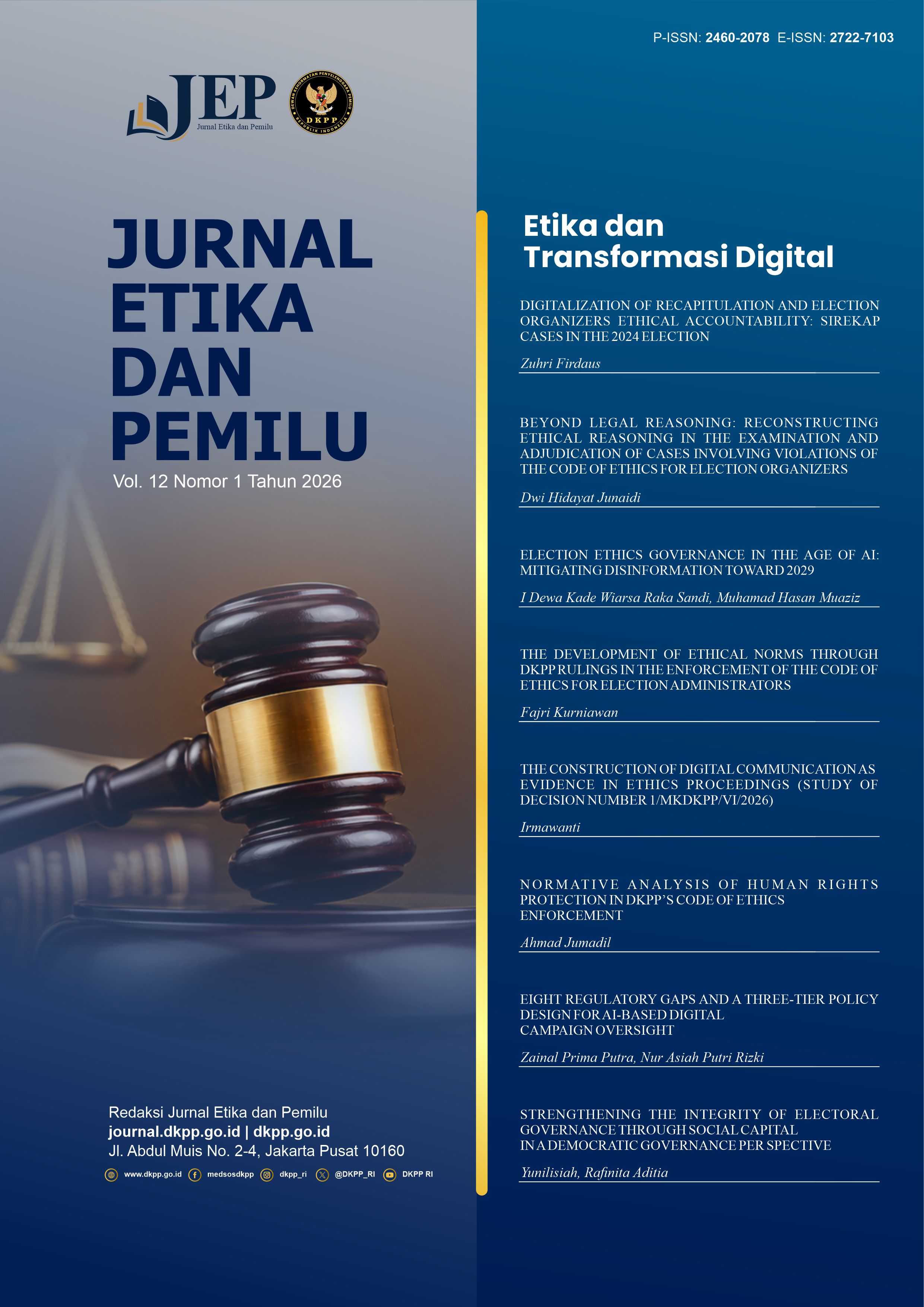
DIGITALIZATION OF RECAPITULATION AND ELECTION ORGANIZERS ETHICAL ACCOUNTABILITY: SIREKAP CASES IN THE 2024 ELECTION
DOI:
https://doi.org/10.68702/etikapemilu.358Keywords:
sirekap, Ethical Accountability, Election Organizers, Digitalization of RecapitulationAbstract
The use of the Recapitulation Information System (Sirekap) in the 2024 Election not only presented technical challenges in the recapitulation process but also raised issues concerning the ethics and responsibility of election organizers. Although research on Sirekap, electoral integrity, and election organizer ethics has developed, the application of ethical accountability in concrete cases involving Sirekap has not been specifically examined through DKPP decisions. This study aims to analyze how the digitalization of recapitulation through Sirekap changes the forms of ethical accountability of election organizers and how ethical prevention and enforcement principles are applied to emerging problems. The study employs a qualitative approach based on document analysis of normative documents and three purposively selected DKPP decisions: Decision No. 53-PKE-DKPP/III/2024, 120-PKE-DKPP/VII/2024, and 179-PKE-DKPP/VIII/2024. The findings show that digitalization does not change the ethical principles applied by DKPP but expands ethical accountability to include the accuracy of published information, the ability to prevent and respond to problems, and the use of access and authority within the system. Problems in Sirekap do not automatically constitute ethical violations, as assessment depends on the actions of election organizers. Thus, strengthening ethical institutionalization requires structural readiness, clear authority for data correction, and digital access traceability.
References
Buku, Bab Buku, Artikel Jurnal, dan Karya Akademik
Asshiddiqie, Jimly. “Memperkenalkan Peradilan Etika.” Jurnal Konstitusi & Demokrasi 1, no. 1 (2021): 1-14. https://doi.org/10.7454/JKD.v1i1.1101
Budhiati, Ida. “DKPP Sebagai Guardian of Etics: Warisan Prof. Jimly dan Implikasi Kelembagaan.” Dalam Etika yang Melembaga: 70 Tahun Prof. Jimly Asshiddiqie, Warisan Gagasan dan Penguatan DKPP, diedit oleh I Dewa ade Wiarsa Raka Sandi, Unu Herlambang, Rahman Yasin dan Cholidin Nasir. 237-259. Jakarta: Sinar Grafika, 2026.
Harun, Daeng, Marwan Djafar, dan Albert Pede. “Pertanggungjawaban KPU terhadap Penggunaan Sirekap pada Pemilu Serentak 2024.” Unisan Law Review 9, no. 2 (2024): 26-40.
Herlambang, Unu. “Dari Rule of Law ke Rule of Ethics: Pelembagaan Etika Penyelenggara Pemilu dan Relevansi DKPP sebagai Peradilan Etik.” Dalam Etika yang Melembaga: 70 Tahun Prof. Jimly Asshiddiqie, Warisan Gagasan dan Penguatan DKPP, diedit oleh I Dewa ade Wiarsa Raka Sandi, Unu Herlambang, Rahman Yasin dan Cholidin Nasir. 172-196. Jakarta: Sinar Grafika, 2026.
Islami, Moh. Iqbal Alam. “Pemungutan, Penghitungan dan Rekapitulasi Suara pada Pemilu Serentak 2024.” Jurnal Bawaslu DKI 9, no. 1 (2024): 101–118. https://journal.bawaslu.go.id/index.php/JBDKI/article/view/452
James, Toby S., dkk. “Electoral Management and the Organisational Determinants of Electoral Integrity.” International Political Science Review 40, no. 3 (2019): 295-312. https://doi.org/10.1177/0192512119828206
Khomsani, Muh Afit. “Integrity of Election Organizers at the Crossroads: An Indonesian Case (2017–2022).” Jurnal Ilmu Sosial Indonesia 6, no. 2 (2025): 77-89. https://doi.org/10.15408/jisi.v6i2.42174
Kurniawan, Fajri, dan M. Naufal Al-Hadi Kasuma. “Code of Ethics and Election Integrity: Measuring the Authority of the DKPP in Enforcement of Indonesian Elections.” Jurnal Etika dan Pemilu 11, no. 1 (2025): 24-41. https://journal.dkpp.go.id/index.php/etikapemilu/id/article/view/299
Malonda, Herwyn J.H. “Etika yang Melembaga: Membaca Rule of Ethics dalam Penegakan Kode Etik dan Pembinaan SDM Penyelenggara Pemilu.” Dalam Etika yang Melembaga: 70 Tahun Prof. Jimly Asshiddiqie, Warisan Gagasan dan Penguatan DKPP, diedit oleh I Dewa ade Wiarsa Raka Sandi, Unu Herlambang, Rahman Yasin dan Cholidin Nasir. 293-317. Jakarta: Sinar Grafika, 2026.
Norris, Pippa. Why Electoral Integrity Matters. Cambridge: Cambridge University Press, 2014.
Nurkamiden, Mario. “SIREKAP: Tantangan dan Potensi Kekeliruan Proses Rekapitulasi Pemilu Serentak di Indonesia.” Sosiologi: Jurnal Penelitian dan Pengabdian kepada Masyarakat 1, no. 2 (2024): 101–110. https://doi.org/10.37905/sjppm.v1i2.62
Paskarina, Caroline, Mustabsyirotul Ummah Mustofa, Rina Hermawati, Eddy Nurmanto, dan Rangga Wardana. “Guarding the People’s Vote: Why Ethics Dimension Matters for Public Trust to E-Recapitulation in the Indonesia 2024 Election.” Cogent Social Sciences 11, no. 1 (2025): 1-17. https://doi.org/10.1080/23311886.2025.2586372
Tinanto, Bherry, A. Zetra, dan R. E. Putera. “Diffusion of Recapitulation Information System (SIREKAP) Innovation in Realizing the Integrity of the 2024 Elections in Meranti Islands Regency, Riau Province, Indonesia.” JPSI (Journal of Public Sector Innovations) 9, no. 1 (2024): 24–33. https://journal.unesa.ac.id/index.php/jpsi/article/view/34391
Yuanita, Alifa. “The Urgency of Enforcing the Code of Ethics of Election Organizers in Facing the 2024 Simultaneous General Elections.” Jurnal Bawaslu Provinsi Kepulauan Riau 6, no. 1 (2024): 45–59. https://doi.org/10.55108/jbk.v6i01.404
Peraturan Perundang-undangan dan Peraturan Lembaga
Komisi Pemilihan Umum Republik Indonesia. Peraturan Komisi Pemilihan Umum Nomor 5 Tahun 2024 tentang Rekapitulasi Hasil Penghitungan Perolehan Suara dan Penetapan Hasil Pemilihan Umum.
Komisi Pemilihan Umum Republik Indonesia. Keputusan Komisi Pemilihan Umum Nomor 219 Tahun 2024 tentang Petunjuk Pelaksanaan Rekapitulasi Hasil Penghitungan Perolehan Suara dalam Pemilihan Umum.
Dewan Kehormatan Penyelenggara Pemilu Republik Indonesia. Peraturan Dewan Kehormatan Penyelenggara Pemilu Nomor 3 Tahun 2017 tentang Pedoman Beracara Kode Etik Penyelenggara Pemilihan Umum.
Putusan, Ketetapan, dan Dokumen Perkara
Putusan Dewan Kehormatan Penyelenggara Pemilu Republik Indonesia Nomor 53-PKE-DKPP/III/2024 perihal Dugaan Pelanggaran Kode Etik Penyelenggara Pemilu Terkait Penggunaan Sistem Informasi Rekapitulasi (Sirekap), 6 Agustus 2024.
Putusan Dewan Kehormatan Penyelenggara Pemilu Republik Indonesia Nomor 120-PKE-DKPP/VII/2024 perihal Dugaan Pelanggaran Kode Etik Penyelenggara Pemilu Terkait Rekapitulasi Menggunakan Sirekap, 1 Oktober 2024.
Putusan Dewan Kehormatan Penyelenggara Pemilu Republik Indonesia Nomor 179-PKE-DKPP/VIII/2024 perihal Dugaan Pelanggaran Kode Etik Penyelenggara Pemilu Terkait Penggunaan Sirekap, 18 November 2024.
Putusan Mahkamah Konstitusi Nomor 32/PUU-XIX/2021 perihal Pengujian Materiil terhadap Pasal 458 ayat (13) Undang-Undang Nomor 7 Tahun 2017 tentang Pemilihan Umum mengenai Frasa "Final dan Mengikat" pada Putusan Dewan Kehormatan Penyelenggara Pemilu (DKPP), 29 Maret 2022.
Downloads
Published
Issue
Section
License
License Terms
1. Copyright Policy
Authors who publish with Jurnal Etika dan Pemilu retain the copyright to their work. By submitting a manuscript, authors grant the journal the right of first publication, with the work simultaneously licensed under a Creative Commons Attribution-NonCommercial 4.0 International License (CC BY-NC 4.0).
2. Creative Commons Attribution-NonCommercial 4.0 (CC BY-NC 4.0)
This license allows others to:
-
Share: Copy and redistribute the material in any medium or format.
-
Adapt: Remix, transform, and build upon the material.
Under the following terms:
-
Attribution: You must give appropriate credit, provide a link to the license, and indicate if changes were made. You may do so in any reasonable manner, but not in any way that suggests the licensor endorses you or your use.
-
NonCommercial: You may not use the material for commercial purposes.
3. Author Rights
Authors retain the right to:
-
Archive their own articles in institutional or subject-based repositories (such as university websites).
-
Use their articles in their own future work, including lectures, books, or personal compilations.
-
Retain intellectual property rights without restrictions, provided that the original publication in Jurnal Etika dan Pemilu is properly cited.
4. User Responsibilities
Users of the journal website must comply with the following:
-
Any redistribution of published content must include a clear citation of the original article, including the author’s name, the title of the article, the journal name, the volume/issue number, and the DOI link.
-
Commercial reproduction or distribution of any content published in this journal is strictly prohibited without the express written permission of the copyright holder (the author) and the journal publisher (DKPP).
5. Third-Party Content
Some materials (such as images, tables, or data sets) published within an article may be subject to third-party copyright. It is the responsibility of the author to ensure that all necessary permissions have been obtained for the inclusion of such materials prior to submission.